
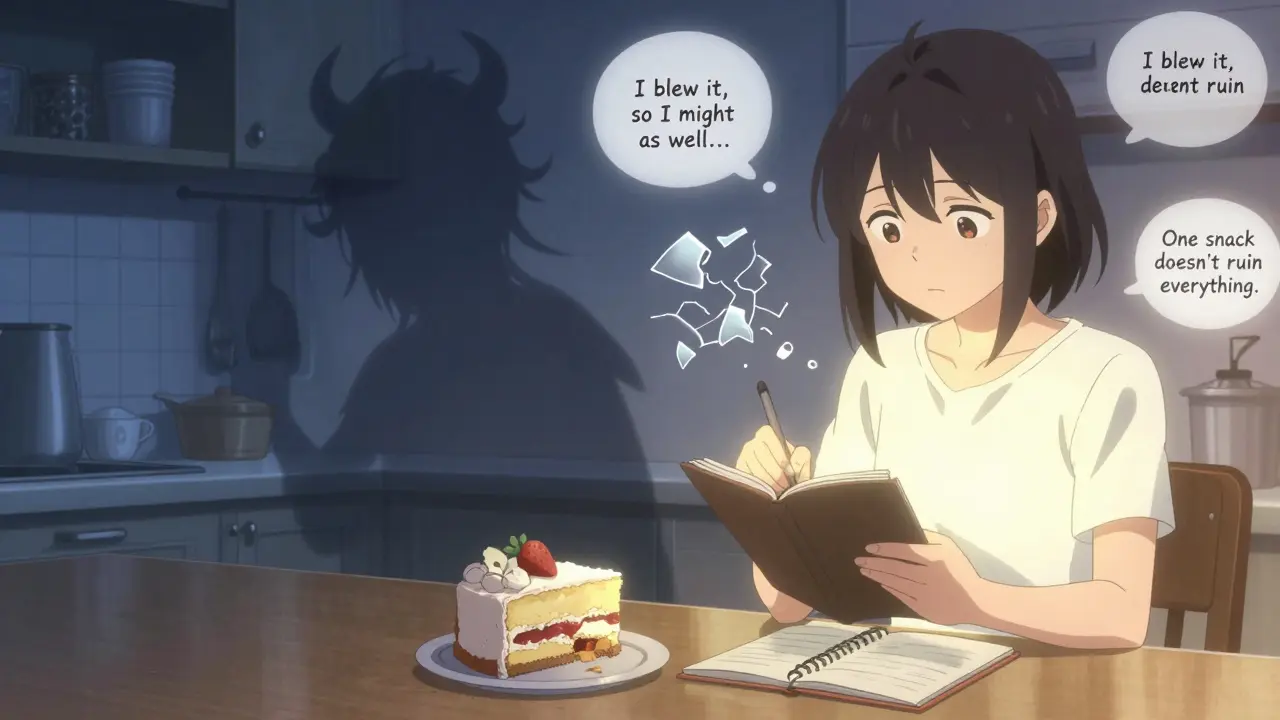
Most people who lose weight gain it back. Not because they lack willpower, but because their thoughts keep sabotaging them. You might have tried diets, counted calories, or hit the gym every morning-only to find yourself back at square one a few months later. The problem isn’t your discipline. It’s your inner dialogue. "I blew it, so I might as well eat the whole cake." "It’s not fair I have to work so hard while everyone else eats whatever they want." These aren’t just excuses. They’re cognitive traps-and they’re exactly what behavioral weight loss therapy was designed to break.
Why Diets Fail and CBT Works
Diets focus on what you eat. Behavioral weight loss therapy focuses on why you eat. It’s built on Cognitive Behavioral Therapy (CBT), a method developed in the 1960s and later adapted for obesity treatment in the 1980s. Unlike diets that tell you to avoid sugar or cut carbs, CBT helps you understand the thoughts behind your cravings, your guilt after eating, and your tendency to give up after one slip-up.
A 2023 meta-analysis of 9 studies involving over 900 people with obesity or type 2 diabetes found that those who did CBT lost an average of 1.6 BMI points more than those who didn’t. That might not sound like much, but it’s statistically significant-and more importantly, it’s sustainable. People who learned to manage their thoughts didn’t just lose weight. They kept it off longer.
Why? Because CBT doesn’t just change behavior. It changes belief. When you stop thinking "I’ll never reach my goal," you stop quitting before you even start.
The 6 Cognitive Strategies That Actually Move the Needle
Not all CBT techniques are created equal. Some work better than others for weight loss. Based on clinical trials and real-world outcomes, here are the six most effective cognitive strategies:
- Cognitive Restructuring - This is the core. It’s about catching distorted thoughts and replacing them with realistic ones. For example, if you think "One cookie ruins everything," you learn to reframe it as "One cookie is just one snack. I can still make healthy choices the rest of the day." Studies show this alone reduces emotional eating by 63%.
- Self-Monitoring - Writing down what you eat and how you feel isn’t just for dietitians. People who track their meals and emotions consistently lose 5-10% more weight than those who don’t. The key? Don’t just log food. Note your mood. Were you stressed? Bored? Lonely? That’s the real trigger.
- Stimulus Control - Your environment is your biggest ally or enemy. If your kitchen is full of snacks, you’ll eat snacks. If your phone is full of food ads, you’ll crave them. CBT teaches you to remove triggers: keep junk food out of the house, unfollow food influencers, and don’t shop when you’re hungry.
- SMART Goal Setting - Vague goals like "lose weight" fail. SMART goals work: Specific, Measurable, Achievable, Relevant, Time-bound. Instead of "I want to eat better," try "I will eat a vegetable with dinner every night this week." Small wins build confidence.
- Problem-Solving for High-Risk Situations - What do you do when your boss takes the team out for pizza? When your partner is stressed and wants to order takeout? CBT doesn’t just prepare you for the gym. It prepares you for real life. You practice responses ahead of time: "I’ll have one slice and a salad," or "Let’s order two healthy dishes and share."
- Relapse Prevention Planning - Slip-ups aren’t failures. They’re data. CBT teaches you to expect them. Instead of spiraling into guilt, you ask: "What triggered this? What can I do differently next time?" People who do this are 40% less likely to regain weight.
CBT vs. Dieting: The Numbers Don’t Lie
Let’s compare what actually works. A 2018 study found that people using CBT lost 8.2% of their body weight in six months. Those on standard diet-and-exercise plans lost 5.1%. The difference? CBT addressed the mind. The diet-only group only addressed the body.
And here’s the kicker: when CBT was combined with Motivational Interviewing (MI)-a counseling style that helps people find their own reasons to change-weight loss jumped to 12.7% at 18 months. That’s nearly double the results of dieting alone. Why? MI reduces shame. It doesn’t tell you what to do. It asks: "What matters to you? Why do you want to change?" That’s what keeps people going.
Dropout rates tell the rest of the story. Standard diet programs lose over half their participants within six months. CBT programs? Only 38.7% drop out. Why? Because CBT gives people tools-not rules. It helps them handle stress, boredom, and emotional pain without turning to food.

Who Benefits Most From CBT for Weight Loss?
CBT isn’t for everyone-but it’s life-changing for certain groups:
- People with Binge Eating Disorder (BED) - More than half of BED patients no longer met diagnostic criteria five years after CBT treatment. That’s not just weight loss. That’s recovery.
- People with depression or anxiety - Studies show CBT for weight loss reduces symptoms of depression and anxiety by 40%. Losing weight feels better when your mind isn’t screaming at you.
- People who’ve tried everything - If you’ve done keto, intermittent fasting, Weight Watchers, and still gained back the weight, CBT might be the missing piece. It’s not another diet. It’s a reset for your thinking.
It’s also especially helpful after bariatric surgery. Many patients lose weight fast but regain it because they never learned how to manage emotions without food. CBT fills that gap. One study found patients who did CBT after surgery rated their ability to stay on track rising from 2 to 7 on a 10-point scale.
The Real Limitations (And What You Can Do About Them)
CBT isn’t magic. It has real drawbacks:
- It takes time - Most programs last 12 to 26 weeks. You won’t see results in two weeks. It takes 8-12 weeks just to learn how to spot your distorted thoughts.
- It’s hard to find a specialist - Only 15% of U.S. counties have a certified CBT obesity therapist. In Australia, access is even spottier outside major cities.
- Insurance rarely covers it - Only 32% of U.S. plans pay for more than 12 sessions. In Australia, Medicare doesn’t currently cover CBT for weight loss unless it’s part of a diabetes program.
- Long-term results are modest - Only 20-30% of people maintain 10% weight loss after two years. That’s better than diets, but not perfect.
So what’s the fix?
Group CBT is the answer. A 2022 study showed group sessions delivered the same results as one-on-one therapy-at one-third the cost. If you can’t find a private therapist, look for a group program through a hospital, community center, or online platform.
Digital CBT apps like Noom or WeightWatchers Beyond the Scale use CBT principles. But here’s the truth: they’re less effective than human-led therapy. A 2023 review found app users lost 3.2% of their weight. Therapist-led CBT? 6.8%. The human connection matters. If you use an app, pair it with a friend or online support group.

The Future: CBT Isn’t Going Away-It’s Evolving
The National Institutes of Health just invested $14.7 million in 2024 to test CBT combined with GLP-1 drugs like semaglutide (Ozempic, Wegovy). Why? Because even powerful medications don’t fix the mindset. You can suppress hunger with a pill-but if you still believe "I deserve this treat after a hard day," you’ll find a way to eat anyway.
CBT teaches you to change that belief. And that’s why it’s here to stay. Even with new drugs, new diets, new gadgets-the real breakthrough will always be learning how to think differently about food, failure, and yourself.
Where to Start Today
You don’t need a therapist to begin. Here’s your 7-day starter plan:
- Day 1-2: Write down every time you eat when you’re not hungry. Note the emotion: stressed? tired? lonely?
- Day 3: Pick one thought that keeps coming up. Write it down. Then write a more realistic version. Example: "I failed my diet" → "I had a tough day. Tomorrow is new."
- Day 4: Remove one food trigger from your environment. Clear out the snacks in your desk drawer or unsubscribe from food delivery ads.
- Day 5: Set one SMART goal for the week. "I will drink water before every meal."
- Day 6: Plan for one high-risk situation. What will you do if your family orders pizza? Write your response.
- Day 7: Reflect: What did you learn about yourself? What thought surprised you?
This isn’t about perfection. It’s about awareness. The moment you notice your mind is lying to you, you’ve already won.
Is behavioral weight loss therapy the same as dieting?
No. Dieting tells you what to eat. Behavioral weight loss therapy teaches you why you eat what you do. It focuses on changing thoughts, emotions, and habits-not just calories or meals. You might still eat the same foods, but you’ll make different choices because your mindset has shifted.
How long does CBT for weight loss take to work?
Most programs run 12 to 26 weeks. You won’t see big changes in the first two weeks. It takes 8-12 weeks to learn how to recognize and reframe your automatic thoughts. Weight loss usually starts showing up around week 6-8, but the real benefit is long-term: people who stick with CBT keep the weight off longer than those on diets.
Can I do CBT for weight loss on my own?
Yes, but with limits. You can use workbooks, apps like Noom, or free CBT exercises online. But studies show therapist-led CBT leads to nearly double the weight loss. If you’re struggling with emotional eating, binge episodes, or depression, working with a trained professional is strongly recommended. Self-guided CBT works best as a starter or maintenance tool.
Does CBT help with cravings?
Not by suppressing them-but by changing how you respond. Cravings don’t disappear. But when you learn that a craving is just a thought (not a command), you stop acting on it automatically. CBT teaches you to pause, identify the trigger (stress? boredom?), and choose a different response-like walking, drinking water, or calling a friend.
What if I slip up? Does that mean CBT didn’t work?
No. Slips are part of the process. CBT doesn’t aim for perfection-it aims for resilience. The goal isn’t to never eat a cookie. It’s to not let one cookie turn into a full binge. When you slip, you ask: "What triggered this? What can I learn?" That’s how progress happens. People who treat slips as data, not failure, are the ones who succeed long-term.
Is CBT covered by insurance in Australia?
Generally, no. Medicare doesn’t currently cover CBT specifically for weight loss unless it’s part of a structured program for type 2 diabetes or obesity-related conditions. Some private health funds may offer rebates under mental health plans if you have a referral from your GP. Always check with your provider. Group programs through hospitals or community centers are often more affordable and may be subsidized.
How do I find a CBT therapist for weight loss?
Start with your GP-they can refer you to a psychologist with experience in obesity or eating behaviors. You can also search through the Australian Psychological Society’s directory, filtering for "clinical psychology" and "eating disorders" or "weight management." Look for therapists who mention CBT, behavioral therapy, or obesity treatment in their profile. Group programs are often available through public hospitals or university clinics.
Final Thought: Your Mind Is the Real Barrier
You’re not failing because you’re weak. You’re stuck because your brain has learned to use food as a coping tool. And that learned pattern can be unlearned. Behavioral weight loss therapy doesn’t promise quick fixes. It promises something better: freedom from the cycle of guilt, shame, and repeated failure. It gives you the tools to eat without fear, to move without punishment, and to live without your thoughts holding you hostage. That’s not just weight loss. That’s liberation.
Comments
Maggie Noe
I literally cried reading this. 🥹 I’ve been stuck in this loop for years-eating when I’m lonely, then hating myself for it. This isn’t just about weight. It’s about finally learning how to talk to myself like a friend instead of a drill sergeant. Thank you for putting this into words.
Gregory Clayton
LMAO another ‘mindset’ fix. You people really think thinking happy thoughts will make the fat melt off? I lost 60 lbs lifting weights and eating clean. No therapy needed. Just stop being weak.
Catherine Scutt
Honestly? This is the most coherent thing I’ve read all week. I used to think CBT was just therapy jargon for ‘try harder.’ Turns out, I was the one not trying-because I didn’t know how to catch my own lies. The ‘one cookie ruins everything’ thing? That’s my exact script. I’m printing this.
Darren McGuff
As a clinical psychologist in London, I’ve seen this work over and over. The magic isn’t in the technique-it’s in the consistency. People think change is dramatic. It’s not. It’s 8 weeks of writing down why you ate that slice of pizza while crying over a breakup. Then one day, you don’t do it anymore. Not because you’re strong. Because you finally understood the trigger.
Alicia Hasö
This is exactly what I’ve been trying to tell my clients for years. Weight loss isn’t a math problem-it’s a psychological one. The number on the scale doesn’t care if you’re exhausted, lonely, or ashamed. But your brain does. And if you don’t address that, you’re just delaying the inevitable. This article doesn’t just inform-it transforms.
Ashley Kronenwetter
The data presented here is methodologically sound. The 2023 meta-analysis referenced shows a clinically meaningful effect size (Cohen’s d = 0.47) for CBT versus control groups. However, generalizability remains limited due to selection bias in recruitment. I recommend cross-referencing with the 2021 Cochrane review on behavioral interventions for obesity.
Heather Wilson
I’ve been doing this for 3 years. I lost 80 lbs. But the real win? I haven’t gained any back. Not because I’m disciplined. Because I finally stopped believing I was broken. When I feel the urge to binge? I don’t fight it. I sit with it. I name it. ‘This is anxiety.’ ‘This is loneliness.’ And then I drink water. Or call my sister. Or just sit in silence. The craving passes. It always does. You’re not weak. You’re just untrained.
Jeffrey Hu
You missed the biggest point. CBT doesn’t work because of ‘thoughts.’ It works because it forces accountability. People who track their food and moods are more likely to self-regulate. It’s not magic. It’s behavioral economics. You’re less likely to do something if you know you have to write it down. That’s why apps like MyFitnessPal work-even if they’re garbage UI. The act of logging changes behavior. CBT just adds the narrative.
Meghan Hammack
I used to think I was lazy. Turns out I was just terrified. Terrified of failing. Terrified of being judged. Terrified that if I lost weight, I’d still feel empty. This article didn’t give me a diet. It gave me permission to be human. I started with Day 1. Wrote down every time I ate out of emotion. By day 4, I cried. Not because I was failing. Because I finally saw the pattern. You’re not alone. I’m right here with you.
Matthew Maxwell
This is why America is collapsing. We’ve turned weight loss into a therapy session. Back in my day, you just ate less and moved more. No journaling. No ‘emotional triggers.’ Just discipline. If you can’t control your appetite, maybe you shouldn’t be eating. This soft approach just encourages weakness.
Jacob Paterson
Oh wow. So now we’re blaming your ‘inner dialogue’ for eating a bag of chips? Next they’ll say your childhood trauma made you choose fries over salad. I’ve got news: you’re not a victim. You’re a grown adult with a fridge. Stop making excuses. Just stop eating.
Angela Stanton
CBT for weight loss is essentially a placebo with a DSM-5 sticker. The 1.6 BMI point difference? Statistically significant, yes-but clinically negligible. And the 38.7% dropout rate? That’s still higher than most pharmaceutical interventions. Also, ‘SMART goals’? Please. That’s kindergarten-level goal-setting. This article reads like a TED Talk written by a grad student who just passed their comps.
Kiruthiga Udayakumar
I tried this in India. Took 6 months. Lost 15 kg. But the real change? I stopped hating my body. My mom said, 'Why do you need to be thin? You're beautiful.' But I didn't believe her. Until I started writing down my thoughts. Now I say: 'I am not my weight.' And that? That's the real win.