
BPH Decongestant Risk Calculator
Risk Assessment
This calculator helps assess your personal risk of urinary retention when taking decongestants based on your prostate health and medication use. Remember, even mild BPH can become dangerous with certain medications.
Your Risk Assessment
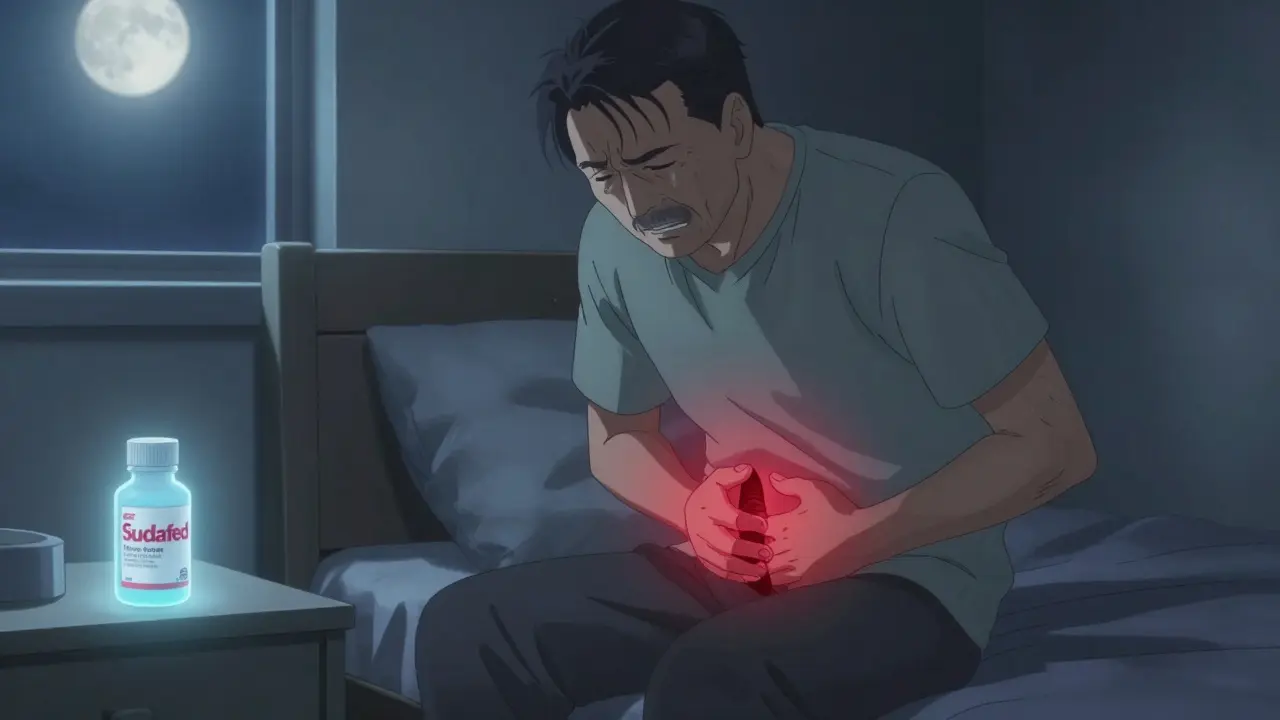
Men over 50 with an enlarged prostate - a condition called benign prostatic hyperplasia (BPH) - need to be extremely careful about what cold and flu medicines they take. A common over-the-counter decongestant can suddenly turn a mild urinary issue into a medical emergency. It’s not just a warning on the label. It’s a real, documented, and often overlooked danger that sends hundreds of men to the hospital every year.
What Is BPH, Really?
Benign prostatic hyperplasia isn’t cancer. It’s not rare. By age 60, about half of all men have some degree of prostate enlargement. By 85, that number jumps to 90%. The prostate sits right below the bladder and wraps around the urethra - the tube that carries urine out of the body. As it grows, it squeezes the urethra. That’s why men with BPH often struggle to start urinating, have a weak stream, feel like they’re not fully emptying their bladder, or wake up multiple times at night to go.
The problem isn’t just discomfort. It’s function. The bladder has to work harder. Over time, it thickens and becomes overactive. But when you add certain medications into the mix, things can go downhill fast.
How Decongestants Make BPH Worse
Most decongestants - especially pseudoephedrine (found in Sudafed) and phenylephrine - work by tightening blood vessels in the nose to reduce swelling. But they don’t stop there. These drugs are alpha-adrenergic agonists. That means they activate receptors in smooth muscle tissue. And guess where else those receptors are? In the prostate and the bladder neck.
When these receptors get stimulated, the muscles in the prostate and around the urethra contract. That’s fine in a healthy prostate. But in a man with BPH, the prostate is already pressing on the urethra. Add muscle contraction on top of that, and the urethra can close completely. This is called acute urinary retention. You feel the urge to pee. You strain. Nothing comes out. Your bladder fills up, painfully. And you can’t go.
Studies show this isn’t rare. A 2021 study in the Journal of Urology found that men with BPH who take decongestants are 2.8 times more likely to develop acute urinary retention. Pseudoephedrine is the biggest offender. A 2022 meta-analysis showed it increases the odds by more than 3.4 times. Even a single 30mg dose - the standard tablet - can trigger symptoms within hours.
Why Pseudoephedrine Is the Worst Culprit
Not all decongestants are equal. Pseudoephedrine has a long half-life - 12 to 16 hours. That means it stays in your system all day, keeping pressure on your prostate. Urodynamic studies show it increases urethral resistance by 35-40%. In men over 70 with moderate to severe BPH, one study found that 51.8% developed subclinical voiding dysfunction after just one dose.
Phenylephrine, another common decongestant, is a bit less potent - about 15-20% increase in resistance - but still risky. Nasal sprays like oxymetazoline are safer because they’re absorbed locally and don’t reach the prostate in significant amounts. But pills? Those go straight into your bloodstream.
The FDA required updated labels on all pseudoephedrine products in January 2022. The warning now says clearly: “Do not use if you have an enlarged prostate.” Yet, a 2023 report found that 73% of pseudoephedrine sales happen without any pharmacist counseling about BPH risk. That’s a gap - and it’s dangerous.

Real Stories, Real Consequences
On Reddit, a user named u/BPH_Warrior described how a single Sudafed tablet led to complete urinary retention. “I could feel my bladder filling but couldn’t push anything out,” he wrote. “It took 12 hours until the medication wore off. I had to go to the ER.”
On the Prostate Cancer Foundation forum, 76% of 187 men reported urinary problems after taking pseudoephedrine. Over 30% needed emergency catheterization. In a Healthline survey of 1,245 men with BPH, 68% said their symptoms got worse after decongestant use - with an average 4.7-point spike on the International Prostate Symptom Score (IPSS). That’s not a small change. That’s moving from mild to moderate or severe.
And it’s not just men with severe symptoms. One man on Drugs.com, age 68, said he’d taken Sudafed for years with no issues. But that’s luck, not safety. Risk varies. Some men can handle it. Others can’t. And you won’t know until it’s too late.
What Should You Do Instead?
You don’t have to suffer through congestion. There are safer options.
- Saline nasal irrigation - using a neti pot or NeilMed Sinus Rinse - works for 68% of people. No drugs. No side effects. Just salt water flushing out the nasal passages.
- Intranasal corticosteroids - like fluticasone (Flonase) - reduce inflammation in the nose. They’re effective in 72% of cases and have zero impact on the prostate.
- Loratadine (Claritin) - if you need an antihistamine, pick this one. It has minimal anticholinergic effects. First-generation antihistamines like diphenhydramine (Benadryl) are worse - they increase urinary retention risk by nearly 3 times.
- Steam inhalation - a hot shower or bowl of hot water with a towel over your head can open nasal passages naturally.
These alternatives aren’t just safer. They’re proven. A 2022 Cochrane Review confirmed saline irrigation is as effective as many decongestants for congestion - without the risk.
When Decongestants Might Still Be Used - With Caution
Some experts say occasional, low-dose use might be acceptable - but only under strict conditions. Dr. Roger Dmochowski of Vanderbilt suggests it might be okay for men with very mild BPH (IPSS score under 8) if used for just one or two days and under doctor supervision.
If you absolutely must use pseudoephedrine, there’s a protocol:
- Start a low-dose alpha-blocker like tamsulosin (0.4mg) at least 72 hours before taking the decongestant. This relaxes prostate muscles and can cut retention risk by 85%.
- Never exceed 30mg of pseudoephedrine in a single dose.
- Use it for no more than 48 hours total. The Prostate Cancer Foundation calls this the “48-hour rule.”
- Watch for warning signs: decreased urine flow, increased straining, feeling like your bladder is full but nothing comes out. If this happens, stop the decongestant immediately.
Even then, it’s not risk-free. The European Association of Urology says the safest approach is complete avoidance of all systemic alpha-adrenergic agonists in men with BPH. Their guidelines say 92% of medication-induced urinary retention cases can be prevented with proper medication review.

What Your Doctor and Pharmacist Should Be Doing
By 2023, 78% of urology practices in the U.S. now include decongestant avoidance in routine BPH management. The American Pharmacists Association recommends that pharmacists screen every man over 50 for BPH before selling any decongestant. That means asking: “Do you have trouble urinating?”
If your pharmacist doesn’t ask, ask them. Say: “I have an enlarged prostate. Is this safe?”
The American Geriatrics Society’s 2023 Beers Criteria lists pseudoephedrine as a “potentially inappropriate medication” for men over 65 with BPH. That’s not a suggestion. It’s a clinical red flag.
What’s Coming Next
There’s new hope. A $2.3 million NIH trial is testing a combination therapy that blocks the retention effect of decongestants. Purdue Pharma’s experimental drug PF-06943303 showed 92% effectiveness in preventing urinary retention in Phase II trials. The FDA granted it Priority Review status in August 2023.
Meanwhile, the American Urological Association and the American College of Allergy are pushing for allergists to screen male patients over 50 for BPH before prescribing decongestants. It’s a small change - but it could save lives.
Bottom Line
If you have BPH - even mild - avoid pseudoephedrine. Don’t assume you’re fine because you’ve taken it before. Your prostate changes. Your body changes. What was safe last year might not be safe today.
Saline rinses, nasal sprays, and non-sedating antihistamines are your best friends. Talk to your doctor. Ask your pharmacist. If you feel like your urine stream has slowed, or you’re straining more than usual after taking a cold medicine - stop it. Call your doctor. Don’t wait until you can’t pee at all. That’s not a minor inconvenience. That’s an emergency.
The science is clear. The warnings are real. And the consequences? They’re serious.
Comments
Ashlyn Ellison
Just took Sudafed last week for a cold. Felt like my bladder was a water balloon about to pop. Didn't think twice until I couldn't pee. Took 3 hours. Scared the hell out of me. Never again.
Tom Forwood
Bro, this is why I stopped buying anything with pseudoephedrine. My dad had to get a catheter after one tablet. He’s 71, thought he was fine because he’d taken it since the 90s. Turns out, your prostate doesn’t care about your history. It only cares about what’s in your bloodstream right now.
Saline rinse? Game changer. I use it every night. No meds. No panic. Just salt water and peace.
Chelsea Cook
Oh honey. You took Sudafed? And you’re still standing? Bless your heart. You’re either lucky or already on tamsulosin and didn’t tell us. 😏
PS: If your pharmacist didn’t ask you about urination issues, they’re not doing their job. And if you didn’t ask them back? You’re part of the problem.
Monica Warnick
Let me tell you about my neighbor. 74, diabetic, BPH, took Sudafed because "it’s just one pill." Went to the ER with a 1,200cc bladder. Catheter for three days. His son had to quit his job to care for him. All because he didn’t read the label. Or worse-he read it and thought "it won’t happen to me."
That’s not ignorance. That’s arrogance wrapped in a cold medicine bottle. And now he’s on a 30-day meds review with his urologist. Good. He should be.
Ryan Vargas
There’s a deeper systemic failure here. The FDA mandated a label update, but didn’t enforce pharmacist counseling. That’s not regulation-it’s theater. The pharmaceutical industry profits from ignorance. Decongestants are sold like candy. No ID check. No warning screen. No mandatory consultation. Just a shelf next to cough drops and aspirin.
Meanwhile, the NIH is funding a $2.3M trial to *counteract* the very effect that should’ve been prevented by *basic pharmacological literacy*. We’re treating symptoms of a policy failure. We’re not fixing the policy.
Alpha-blockers before pseudoephedrine? That’s not a solution. That’s damage control. The real solution is removing systemic alpha-agonists from OTC shelves entirely. Period.
Simon Critchley
Yo, I’ve been doing this for 15 years. Pseudoephedrine = alpha-1A agonist = detrusor sphincter dyssynergia risk. Phenylephrine? Slightly better, but still a 15-20% urethral resistance spike. Saline irrigation? 68% efficacy. Flonase? 72%. And zero prostatic impact.
Meanwhile, diphenhydramine? 3x higher retention risk. Anticholinergic burden = bladder atony. You’re not just avoiding decongestants-you’re avoiding a polypharmacy nightmare.
Pro tip: If you’re over 50 and using OTC meds, keep a log. Track IPSS scores. Your urologist will thank you. And your bladder? It’ll thank you more.
Brett Pouser
Man, I’m from Texas. We don’t take warnings lightly here. But I’ve seen too many guys ignore this stuff. "I’ve taken it before." "I’m fine."
Here’s the thing-your body’s not the same as it was at 40. Prostate grows. Bladder weakens. Medications don’t care about your past. They only care about your present.
Try the neti pot. It’s weird at first. Feels like your nose is doing yoga. But you’ll feel like a new man. No ER visits. No catheters. Just… breathing.
And if you’re still skeptical? Ask your pharmacist. Just say: "I’ve got BPH. Is this safe?" If they hesitate? Walk away.
John McDonald
Listen. This isn’t about being scared. It’s about being smart. You don’t need to live in fear. You just need to be informed.
Saline rinse? Do it. Flonase? Do it. Claritin? Do it.
And if you’ve got a cold and you’re thinking about Sudafed? Pause. Breathe. Ask yourself: "Is this worth a catheter?"
It’s not. Not even close.
Protect your bladder like it’s your last paycheck. Because one day, it might be.
Andy Cortez
LMAO this post is wild. So now we’re telling men they can’t take Sudafed? What’s next? No aspirin for heartburn? No caffeine for fatigue? Next thing you know, we’ll be banned from breathing too hard.
I’ve taken it for 20 years. No issues. My prostate? Fine. Your prostate? Maybe yours is a drama queen.
Also, who the hell is funding this? Pharma? Urologists? I’m just saying… maybe the real danger is fearmongering.
Jacob den Hollander
Hey Andy, I hear you. But I’ve been in the ER twice because of this. Once for myself, once for my uncle. Neither of us thought we were at risk. We were wrong.
It’s not about fear. It’s about facts. 2.8x higher risk. 51.8% of men over 70 develop dysfunction after one dose. 73% of sales happen without counseling.
I’m not trying to scare you. I’m just saying: your body changes. Your meds don’t. So you gotta change how you think about them.
Try the neti pot. It’s cheap. It’s safe. And it works. You’ve got nothing to lose.
And if you’re still skeptical? Talk to your doctor. Don’t guess. Don’t Google. Just ask.
Karianne Jackson
I had to pee so bad but couldn’t. Felt like I was gonna explode. Called 911. They came. Catheter. I cried. I’m 62. I’m not dumb. But I didn’t know. Now I know. Don’t be like me.