
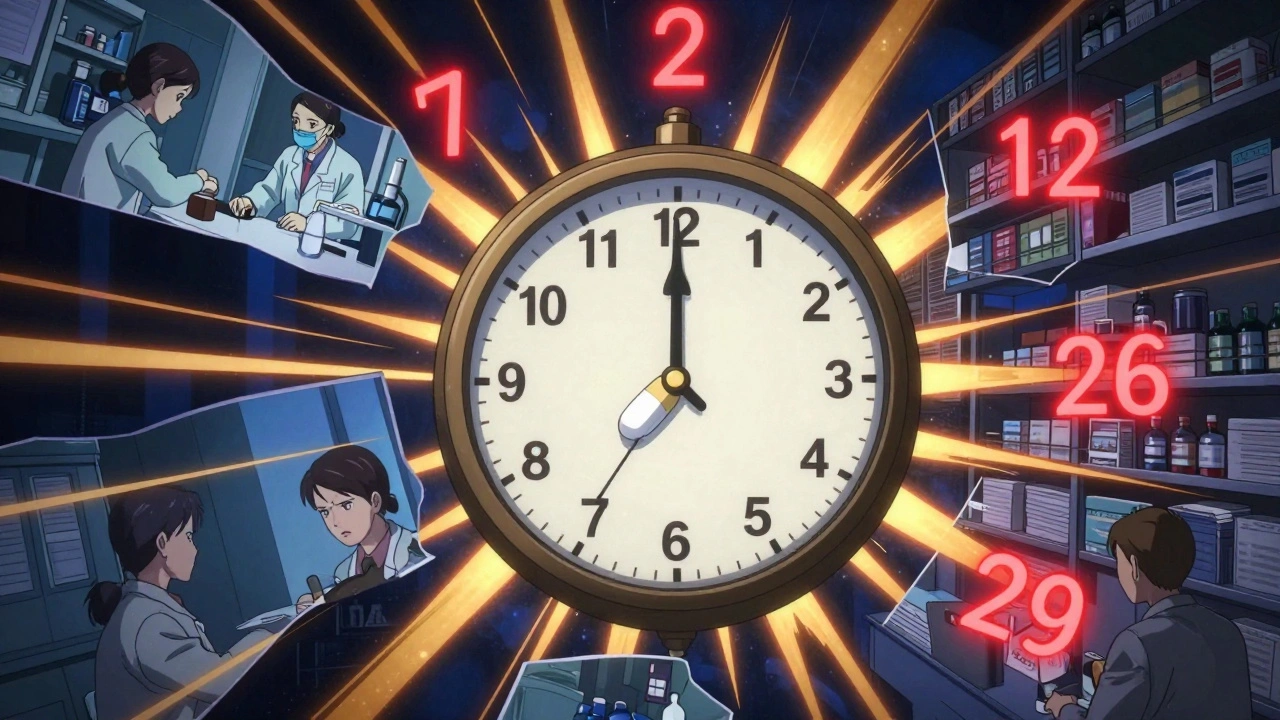
Most people assume a pharmaceutical patent lasts 20 years. That’s what the law says. But if you look at when a drug actually hits the market, the real window for profits is often less than half that time. Why? Because the clock starts ticking long before patients ever see the medicine.
The 20-Year Myth
The U.S. patent system grants inventors 20 years of protection from the date they file the application. That sounds straightforward. But for drugs, filing happens during early research-sometimes years before human trials even begin. By the time a drug clears clinical testing, gets reviewed by the FDA, and finally reaches pharmacies, five to ten years have already passed. That means the company has maybe 10 to 15 years left to make back the billions they spent developing it.It’s not a flaw-it’s built into the system. The patent isn’t meant to protect sales; it’s meant to protect innovation. But the delay between filing and approval creates a brutal mismatch. A drug approved in 2025 might have been patented in 2010. That’s 15 years gone before the first pill is sold. And that’s before you even factor in the time it takes to scale manufacturing or train doctors to prescribe it.
What the Hatch-Waxman Act Actually Did
In 1984, Congress passed the Hatch-Waxman Act to fix this imbalance. It wasn’t just about speeding up generics. It was about giving innovators a fair shot. The law allowed for Patent Term Extension (PTE)-a way to add back some of the time lost during FDA review.Here’s how it works: if a drug spends seven years in clinical trials and regulatory review, the company can apply to extend its patent by up to five years. But there’s a hard cap: no extension can push the total exclusivity beyond 14 years after FDA approval. That’s the real limit. Even with the extension, most drugs get 12 to 15 years of market exclusivity after launch-not the full 20 from filing.
And here’s the catch: only one patent per drug can be extended. That means companies can’t just pile on extensions for every patent they hold. The law was designed to protect the core innovation, not every minor tweak.
Regulatory Exclusivity: The Hidden Clock
Patents aren’t the only protection. The FDA also gives out regulatory exclusivities, which are completely separate. These don’t depend on patents at all. They kick in when the drug gets approved.- New Chemical Entity (NCE) Exclusivity: 5 years of protection from generic copies. During this time, the FDA can’t even accept an application from a competitor.
- New Clinical Investigation Exclusivity: 3 years for new uses, new formulations, or new patient groups-not the same molecule, but new data.
- Orphan Drug Exclusivity: 7 years for drugs treating rare diseases (fewer than 200,000 patients in the U.S.).
- Pediatric Exclusivity: An extra 6 months added to any existing patent or exclusivity period if the company tests the drug in children.
These aren’t just bonuses-they’re powerful tools. A drug might lose its patent in 2028, but still be protected by NCE exclusivity until 2030. That’s two extra years of monopoly pricing. And if the company runs a pediatric study? That’s another six months tacked on.
The Evergreening Game
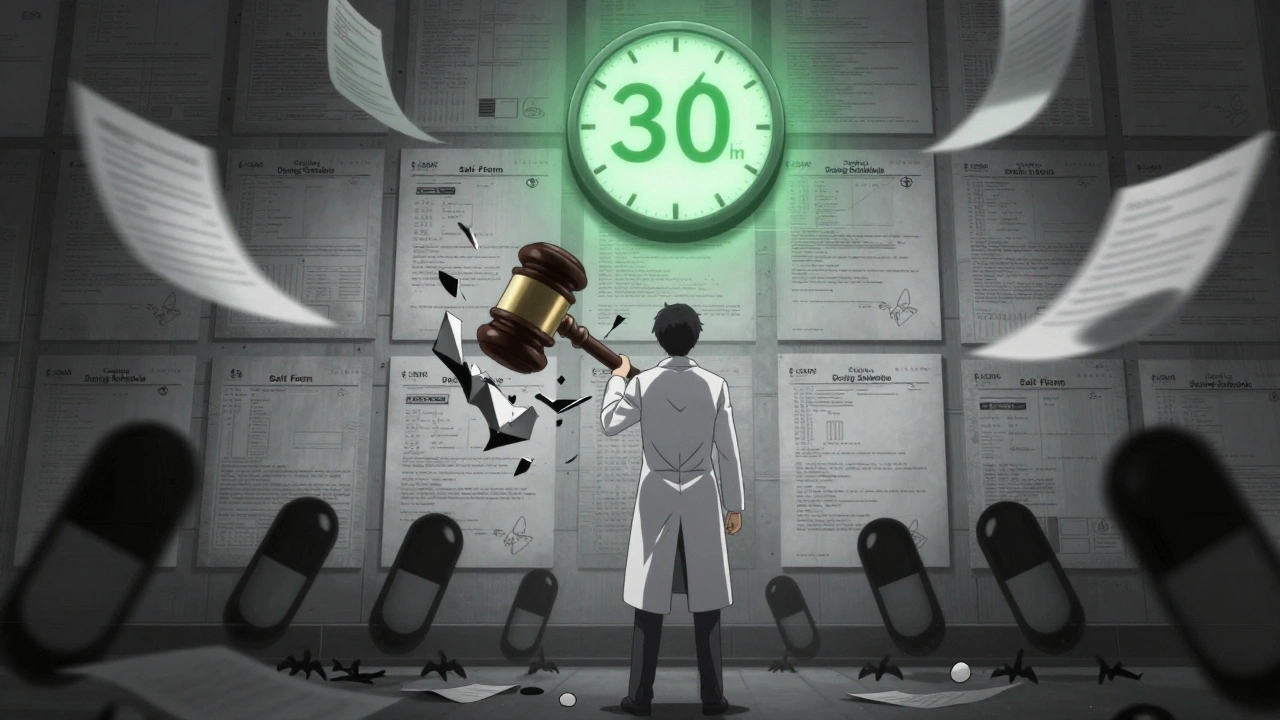
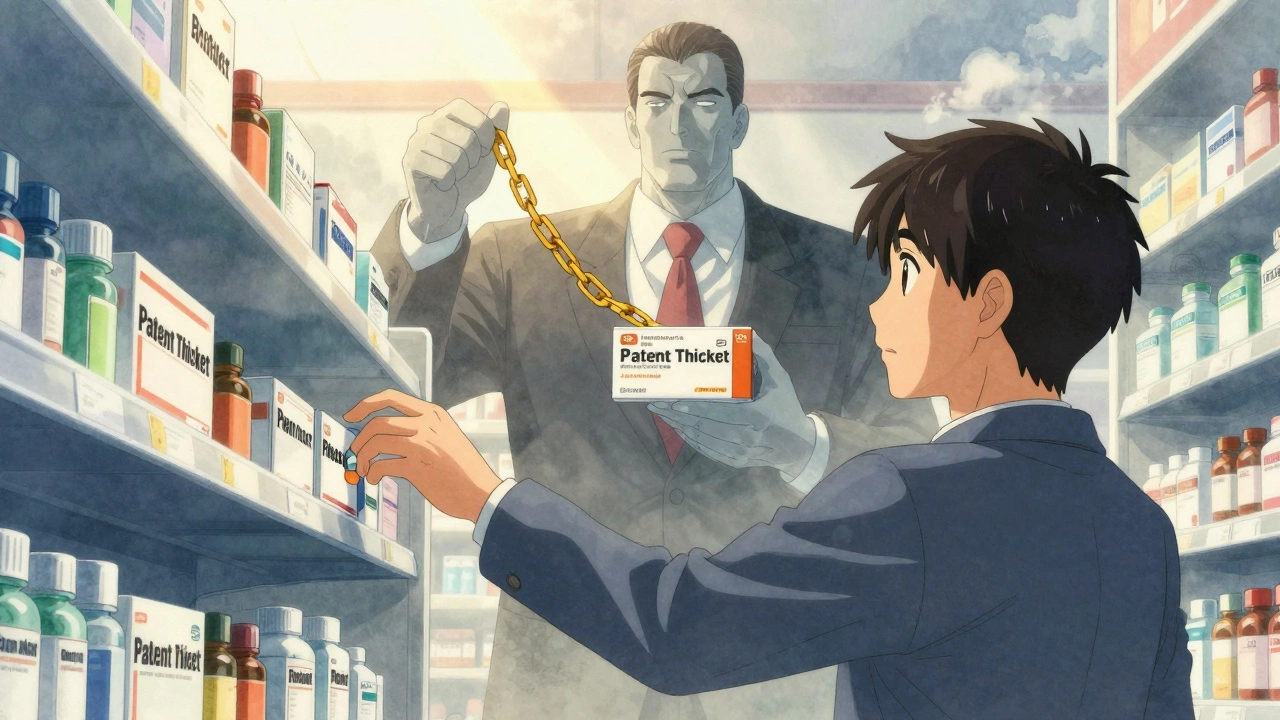
When the core patent starts to expire, smart companies don’t just wait. They file new patents on tiny changes: a new pill coating, a slightly different salt form, an extended-release version, or a combination with another drug. These are called secondary patents.A 2023 study by the R Street Institute found that blockbuster drugs-those making over $1 billion a year-average 20 to 30 patents each. Many are filed after approval. One drug might have a patent on the molecule, another on the tablet shape, another on how it’s taken with food, another on a new dosing schedule. Together, they create what experts call a patent thicket.
It’s legal. But it’s also strategic. Generic manufacturers can’t enter the market until every patent is challenged and invalidated-or expires. And because each new patent triggers a 30-month legal delay, companies can stretch exclusivity for years beyond the original term. In fact, 91% of drugs that get patent extensions still hold monopolies long after those extensions end, thanks to this tactic.
How the System Compares Around the World
The U.S. isn’t alone. Other countries have similar systems, but with different rules.- Canada: Offers a Certificate of Supplementary Protection (CSP) that adds up to 24 months after patent expiry.
- Japan: Allows up to five years of patent term extension, similar to the U.S., but with stricter review.
- European Union: Uses Supplementary Protection Certificates (SPCs), which can extend protection for up to five years, with a maximum of 15 years total from market approval.
But here’s the key difference: in the U.S., the FDA doesn’t control patents. The Patent Office does. That means a drug can have a patent that expires in 2027, but still be protected by regulatory exclusivity until 2031. In Europe, the system is more tightly linked. The result? U.S. drugs often enjoy longer exclusivity periods than similar drugs elsewhere.
The Economic Stakes Are Massive
When a drug loses exclusivity, prices drop fast. Within a year, generics can cut the original price by 80 to 90%. That’s why companies spend billions defending their patents.For example, a drug with $2 billion in annual sales that loses exclusivity in 2026 could lose $1.6 billion in revenue by 2027. That’s why pharmaceutical firms invest heavily in lifecycle management-new formulations, new delivery methods, new indications-all designed to extend the clock.
By 2025, global sales of drugs facing patent expiration are projected to hit $250 billion. That’s not just corporate profit-it affects insurance costs, pharmacy budgets, and patient access. When a top-selling drug goes generic, Medicaid and Medicare save billions. But if companies delay generic entry with patent thickets, those savings are pushed back.
What’s Next? The Pressure Is Building
Critics say the system is broken. The Hatch-Waxman Act was meant to balance innovation and access. Today, it’s being used to lock in monopolies far beyond what lawmakers intended. Courts are starting to take notice. Recent lawsuits have challenged secondary patents on trivial changes, calling them “evergreening.”Regulators are also under pressure. The FDA has started cracking down on patents that don’t reflect real innovation. And Congress has debated reforming patent term extensions to cap them more strictly.
But for now, the game continues. Companies will keep filing patents. Courts will keep ruling. And patients will keep waiting for cheaper versions of life-saving drugs.
The truth? Effective patent life isn’t about the law on paper. It’s about how companies use the law-and how the system lets them.
How long is the average effective patent life for a new drug in the U.S.?
The average effective patent life for a new drug in the U.S. is about 12 to 15 years after FDA approval. This includes the original patent term (minus time spent in development) plus any patent term extension and regulatory exclusivities. The nominal 20-year patent term from filing rarely translates to more than 15 years of market exclusivity.
Can a drug have more than one patent?
Yes. Most drugs have multiple patents: one for the active ingredient, others for formulations, methods of use, manufacturing processes, or delivery systems. These are called secondary patents. While only one patent can be extended under Hatch-Waxman, companies often file dozens to delay generic competition. Blockbuster drugs may have 20 to 30 patents.
What’s the difference between a patent and regulatory exclusivity?
A patent protects the invention itself and is issued by the U.S. Patent and Trademark Office. It can be filed at any time during development. Regulatory exclusivity is granted by the FDA after approval and protects the drug from generic competition regardless of patent status. Exclusivity periods include 5 years for new chemical entities, 3 years for new clinical data, and 7 years for orphan drugs.
Why do generic drugs take so long to appear after a patent expires?
Even after a patent expires, generics can be delayed by other patents, regulatory exclusivities, or legal challenges. If a brand company sues a generic manufacturer within 45 days of receiving a notice of intent to sell, the FDA must wait 30 months before approving the generic-unless a court rules in the generic’s favor earlier. This is called the 30-month stay.
Does the FDA list all patents on a drug?
Yes. All patents associated with a branded drug are listed in the FDA’s Orange Book. This public database helps generic manufacturers identify which patents they need to challenge before launching a copy. But not every patent listed is valid or enforceable-many are secondary patents that courts later invalidate.
Comments
Jane Quitain
so like... the patent clock starts ticking before the drug even exists?? that feels like getting fined for running a red light before the light was installed 😅
David Brooks
OMG THIS IS WHY MY INSURANCE IS SO HIGH 😭
They’re not just making drugs-they’re playing chess with time, patents, and my wallet. I didn’t know 20 years was a myth. Now I get why my insulin costs $300. This is wild.
Olivia Hand
It’s fascinating how the system was designed to incentivize innovation, but the loopholes have become a corporate playbook. The patent thicket strategy isn’t just clever-it’s predatory. When a company files 27 patents on a pill’s coating, color, and recommended time of day to swallow it, you’re not protecting innovation. You’re weaponizing bureaucracy.
And the FDA’s Orange Book? It’s less a public service and more a minefield for generics. I’ve seen small biotechs fold trying to navigate it. The 30-month stay? It’s a legal chokehold disguised as due process.
Meanwhile, patients in other countries get cheaper versions years earlier. Canada’s 24-month CSP? That’s a Band-Aid. The U.S. system isn’t broken-it was built this way. And the real tragedy? The people who need these drugs most can’t wait for a court ruling.
Desmond Khoo
bruh i just found out my anxiety med’s patent expires next year and i’m already panicking 😅
like… i don’t even know what generic even means here. do i just get the same pill but without the fancy logo??
also why does every drug have like 15 patents?? is the pharma industry just trying to win a patent bingo tournament?? 🤯
Louis Llaine
So let me get this straight-companies spend 10 years developing a drug, then spend the next 10 years suing people who try to make the same thing.
And we call this ‘innovation’?
Yeah, I’ll take my ‘free market’ right out the window.
Also, ‘evergreening’? More like ‘evergreening my bank account’.
Sam Mathew Cheriyan
you know what’s really happening? Big Pharma is working with the FDA to keep prices high so the deep state can control the population. they don’t want you healthy, they want you dependent. also, the 20-year patent? that’s just the tip of the iceberg. the real clock starts when the vaccine was designed in a lab in 2018. they’ve been planning this since before you were born.
Nancy Carlsen
Thank you for explaining this so clearly 💙
As someone who’s watched a loved one struggle with rare disease meds, I never realized how much the system *could* help-if it wasn’t so tangled.
Orphan drug exclusivity? That’s a lifeline. But when big companies game the system with minor tweaks? It breaks my heart.
Let’s push for reform that honors both innovation AND access. We can do better.
Ted Rosenwasser
Frankly, anyone who thinks the Hatch-Waxman Act was designed for patients is either naive or misinformed. It was a corporate bailout disguised as public policy. The 14-year cap? Arbitrary. The patent term extension? A loophole engineered by lobbyists with law degrees from Yale.
And let’s not pretend the FDA is impartial. Their relationship with pharma is a revolving door disguised as regulation. If you think this is about science, you haven’t read the SEC filings.
Ashley Farmer
Reading this made me realize how little I understood about how drugs get to market.
It’s not just about money-it’s about timing, bureaucracy, and who gets left behind.
Thank you for laying this out without jargon. I’m going to share this with my book club. We need more people to know how the system really works.
Nicholas Heer
THEY’RE STEALING OUR HEALTHCARE AND CALLING IT ‘PATENT PROTECTION’!!
THIS IS A GLOBALIST CONSPIRACY TO MAKE AMERICANS PAY MORE FOR PILLS SO THEY CAN FUND THE NEW WORLD ORDER!!
THE FDA IS A BRANCH OF THE WORLD ECONOMIC FORUM AND THE ORANGE BOOK IS A SECRET CODE FOR ELITE CONTROL!!
EVERY TIME YOU BUY A BRAND NAME DRUG, YOU’RE FUNDING THE DEEP STATE!!
WE NEED TO BURN THE PATENT OFFICE AND RETURN TO HERBS!!
Sangram Lavte
in india we get generics way faster. like, if a drug patent expires in us, we have it in 3 months. no lawsuits, no delays. just cheap, effective medicine.
but yeah, the u.s. system is… something else. i feel bad for people there.
Stacy here
It’s not about patents. It’s about power.
Every pill you take is a transaction in a metaphysical economy where time is currency and suffering is collateral.
Pharma doesn’t sell drugs-they sell the illusion of control over mortality.
The 20-year myth? It’s a narrative to pacify the masses while the elite hoard the science of life itself.
When you take your medication, you’re not healing-you’re participating in a ritual of corporate transcendence.
And the FDA? They’re not regulators. They’re the priesthood of the pharmaceutical cult.
Wake up. The patent clock isn’t ticking-it’s chanting.
Kyle Flores
Just want to say thanks to the author for breaking this down. I’m a nurse and I see patients struggle with this every day.
Some of them skip doses because they can’t afford the brand name. Others wait months for generics that never come.
It’s not just policy-it’s people.
Let’s push for change that puts patients first, not patents.