
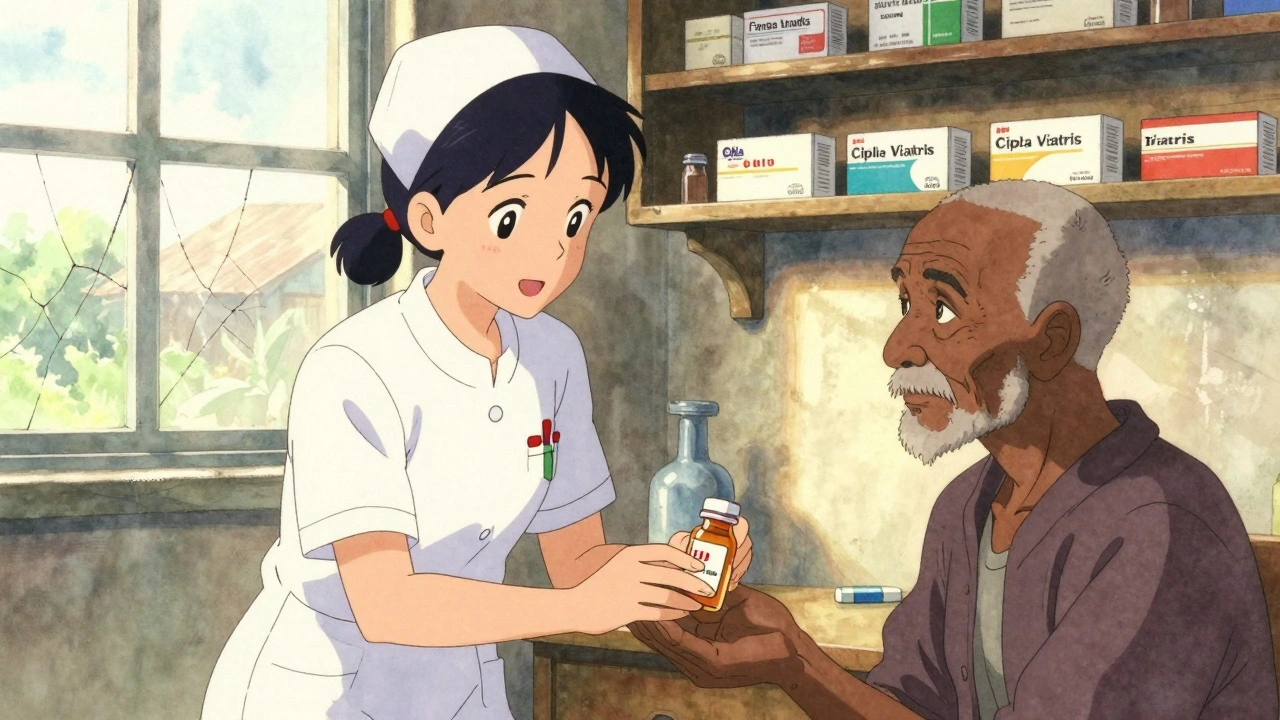
Imagine needing a life-saving drug, but it costs three months’ wages. For over 2 billion people around the world, this isn’t a hypothetical. It’s daily reality. The answer isn’t more expensive branded pills-it’s generics. These are the same medicines, made with the same active ingredients, but sold without patents. And in low-income countries, they’re the only thing standing between life and death for millions.
Why Generics Matter More Than You Think
Generics aren’t just cheaper-they’re transformative. A single course of HIV treatment that once cost $10,000 a year in the U.S. dropped to under $100 in Africa thanks to generic manufacturers like Cipla and Viatris. That’s an 80%+ price drop. When medicines cost less, health systems can treat ten times as many people. In places like Malawi or Bangladesh, where governments spend less than $50 per person on health each year, generics make universal care possible.The science is clear: generics work. They go through the same quality checks as branded drugs. In fact, many are made in the same factories. But here’s the catch: even when generics exist, most people in low-income countries still can’t get them.
The 5% Problem: Why Generics Aren’t Used
In the U.S., 85% of all prescriptions are filled with generic drugs. In low- and middle-income countries? Just 5%. That’s not because people don’t want them. It’s because the system is broken.One reason? Fear. Many patients and even doctors believe generics are inferior. That’s a myth. The WHO confirms that quality-assured generics are just as safe and effective. But misinformation runs deep. In some villages, people will pay double for a branded pill because they’ve heard it’s “stronger.”
Another reason? Supply chains. Even when medicines are available in capital cities, they never reach rural clinics. A 2023 study found that nearly half of public health centers in sub-Saharan Africa had no antimalarials in stock. No matter how cheap the drug is, if it’s not on the shelf, it doesn’t help anyone.
And then there’s the money problem. Nearly 90% of people in developing nations pay for medicine out of their own pockets. That means even a $5 generic antibiotic might be too expensive. A single course of tuberculosis treatment can cost a family a week’s income. That’s why 100 million people are pushed into extreme poverty every year just because they got sick.
Who Makes These Generics-and Why Aren’t They Doing More?
Five companies-Cipla, Hikma, Sun Pharma, Teva, and Viatris-produce 90% of the off-patent drugs needed in low-income countries. They’ve made incredible progress. Cipla’s HIV generics saved millions in Africa. Sun Pharma supplies affordable insulin to India and Nigeria.But here’s the gap: most of these companies focus on volume, not equity. Their business models don’t target the poorest. They sell to governments and big NGOs, but rarely to individuals who can’t pay upfront. A 2024 report from the Access to Medicine Foundation found that out of 102 essential drugs, these five companies had clear access strategies for only 41 of them. And even then, affordability for the poorest patients was rarely part of the plan.
Big pharmaceutical companies like Pfizer and Novartis have “inclusive business models” that reach all 48 low-income countries. But here’s the problem: they don’t say how many people actually get the drugs. No transparency. No data. So we don’t know if they’re reaching the villages that need it most.

The Real Barriers: More Than Just Price
Price isn’t the only issue. The system is stacked against access.Regulations: In many countries, it takes over a year to approve a generic drug. In the U.S., it’s six months. Delays mean people wait-and die.
Tariffs and taxes: Some countries charge 20% import taxes on medicines. That’s like adding $20 to a $100 drug. The Geneva Network says abolishing these taxes alone could cut costs by 15%. Yet few governments act.
Weak health systems: Clinics lack refrigeration, transport, or trained staff. A medicine that needs to stay cold? It spoils before it reaches the patient. A 2022 Lancet study showed medicine availability in public clinics dropped in the Western Pacific and Africa, even as global production rose.
Patent tricks: Some branded drug makers extend patents by making tiny changes to the formula-like adding a new coating or changing the dosage form. This blocks generics for years longer than intended. The WHO calls this “evergreening.” It’s legal, but it’s not ethical.
Where Progress Is Happening
Not all is lost. Real change is happening in pockets around the world.In Rwanda, the government partnered with generic makers to deliver HIV drugs directly to clinics. Today, over 95% of people living with HIV there are on treatment. In India, the government bypassed private distributors and bought insulin directly from manufacturers-cutting prices by 60%.
In Uganda, Gilead ran clinical trials for a new long-acting HIV prevention shot. Patients didn’t need to travel far. They didn’t need to pay. The trial worked-and now the drug is being scaled.
And in Ghana, a new digital system tracks medicine stock in real time. When a clinic runs low, the system automatically orders more. No more empty shelves.
These aren’t miracles. They’re smart policies. Simple fixes: better supply chains, transparent pricing, direct procurement, and local manufacturing.

What Needs to Change
Here’s what actually works:- Remove taxes on medicines: No country should tax life-saving drugs.
- Fast-track generic approvals: Cut approval times from years to months.
- Buy directly from manufacturers: Governments should skip middlemen and buy bulk.
- Support local production: Countries like Ethiopia and Nigeria are building their own generic factories. They need funding and technical help.
- End evergreening: Regulators must stop approving patent extensions that don’t improve health outcomes.
And here’s the hardest truth: money matters. In 2001, African leaders promised to spend 15% of their national budgets on health. In 2022, only 23 of 54 African countries did. Without that investment, no generic drug will save lives.
The Future Is in the Hands of Governments-and Patients
Generics have proven they can work. They’ve turned HIV from a death sentence into a manageable condition. They’ve cut malaria deaths in half. They’ve made insulin accessible to millions.But they won’t reach the people who need them unless systems change. It’s not about more drugs. It’s about fairer systems.
Patients shouldn’t have to choose between medicine and food. Clinics shouldn’t be empty because a shipment got stuck at customs. Governments shouldn’t be paying 20% more for drugs because of outdated rules.
The tools are here. The science is solid. The cost savings are massive. What’s missing is the will.
If you want to know why someone in a rural village still dies of pneumonia-it’s not because the medicine doesn’t exist. It’s because the system forgot them.
Are generic drugs safe in low-income countries?
Yes, when they’re quality-assured. Many generics used in low-income countries are made in facilities inspected by the WHO or U.S. FDA. Countries like India and South Africa produce WHO-prequalified generics that meet international standards. The problem isn’t safety-it’s access. Poor storage, fake drugs, and lack of regulation in some areas create risks, but these are systemic failures, not inherent flaws in generics themselves.
Why don’t low-income countries make their own generics?
Many do-India and Brazil are global leaders. But building manufacturing capacity takes time, money, and technical expertise. Some countries lack infrastructure, trained workers, or regulatory systems. International support, like technology transfer from big pharma or partnerships with WHO, can help. Ethiopia and Nigeria are now building local factories with aid from global health groups.
Do generic drugs work as well as branded ones?
Yes. By law, generics must have the same active ingredient, strength, dosage, and effectiveness as the brand-name version. Studies across Africa and Asia show identical outcomes for HIV, TB, and malaria treatments. The only difference is price-and sometimes, the packaging.
Why do people still buy branded drugs if generics are cheaper?
Because of trust, misinformation, and lack of access. Many patients believe branded drugs are stronger. Pharmacies sometimes stock only branded versions because they earn higher margins. In rural areas, branded drugs may be the only ones available due to poor distribution. Even when generics are present, people pay more out of fear or habit.
How can I help improve access to generics?
Support organizations that fund generic drug production in low-income countries, like the Global Fund or Médecins Sans Frontières. Advocate for policies that remove import taxes on medicines. Push for transparency from pharmaceutical companies about where and how many people receive their drugs. And don’t believe the myth that generics are inferior-they’re one of the most powerful tools we have for global health equity.
Comments
Josh Bilskemper
Generics are fine I guess but you're ignoring the fact that branded pharma funds 90% of R&D. Without profit, no innovation. You want cheap drugs? Fine. But don't pretend the system that made them possible doesn't matter.
Storz Vonderheide
I've worked in rural clinics in Kenya and Nepal. The real issue isn't just price-it's trust. People see a white pill with no logo and think it's fake. We ran education campaigns with local healers and nurses. Within a year, generic adherence jumped 40%. It's not magic. It's communication.
dan koz
In Nigeria, we call branded drugs 'foreign medicine'. Even when generics are right next to them, people pay double because they think the brand means it's from America. Doctors get kickbacks too. It's not ignorance. It's corruption.
Ethan McIvor
It's heartbreaking how we've turned medicine into a commodity instead of a right. We spend billions on war and yet a child dies of pneumonia because a $2 pill never reached her village. What does that say about us as a species? 🤔
Mindy Bilotta
i read somewhere that in ghana they started using text messages to alert clinics when meds are low and it cut stockouts by 70%. why dont more countries do this? its so simple
Michael Bene
Let me break this down for you. You think generics are the answer? Cool. But have you seen the supply chain in rural Zambia? It's a joke. Trucks break down. No refrigeration. Mosquitoes eat the labels. The drugs are good. The system is a dumpster fire. And you want to blame Pfizer? Wake up. The real villains are the local ministers who pocket the aid money and never show up to the clinic. I've been there. I've seen it. And no, your feel-good article won't fix that.
Chris Jahmil Ignacio
You didn't mention the WHO's secret deal with India to flood Africa with substandard generics. They've been caught multiple times. Fake meds are everywhere. And you're acting like generics are pure? The FDA banned 3 Indian factories last year for falsifying data. This isn't a hero story. It's a ticking time bomb.
Paul Corcoran
I love how you highlighted Rwanda and Ghana. That's the blueprint. Simple. Local. Real. We need more of this. Not more speeches. More action. Governments, NGOs, and communities working together. No bureaucracy. No middlemen. Just medicine where it's needed. I've seen it work. It's possible.
Colin Mitchell
My cousin works with a nonprofit in Malawi. They train local pharmacists to identify real vs fake generics. They also teach people how to read the batch numbers. It's small. It's quiet. But it's saving lives. You don't need a global policy. You just need someone to care enough to show up.
Chad Kennedy
I'm tired of this. You're all acting like this is a moral issue. It's not. It's economics. If you can't pay, you don't get the drug. That's how the world works. Stop pretending it's unfair. Life isn't fair. Get over it.
Cyndy Gregoria
I work in public health and I can tell you this: the biggest barrier isn't price or supply. It's stigma. People hide their HIV because they're afraid to be seen picking up generics. They buy branded pills and hide them. We need dignity as much as we need drugs.
Wendy Chiridza
The 5% stat is misleading because it doesn't account for informal markets where unregulated generics are sold without oversight. Those aren't counted in official numbers but they're everywhere. So the real issue is regulation not access
Pamela Mae Ibabao
I know you think this is inspiring but let's be real. Most of these 'success stories' are funded by Western donors. When the money runs out, the clinics go dark. It's not sustainable. It's charity. And charity isn't a system. It's a Band-Aid on a hemorrhage.