
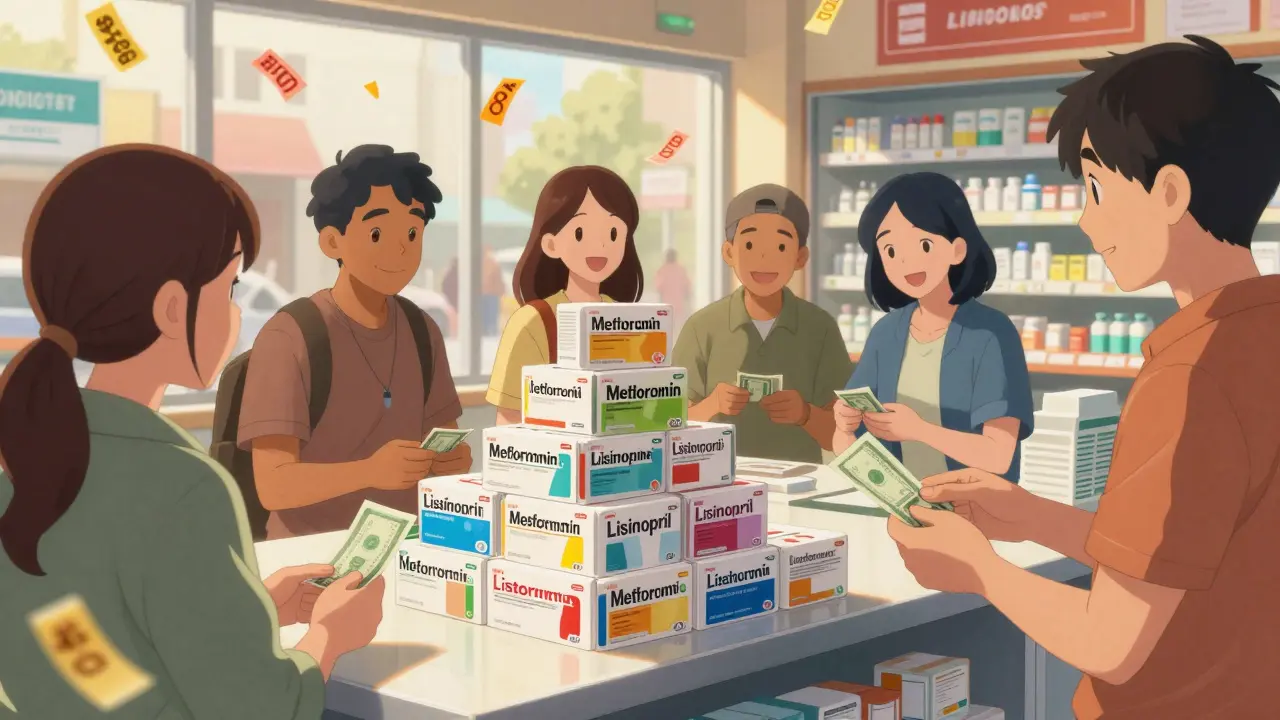
When you fill a prescription for a generic drug like metformin or lisinopril, you might pay less than $10 for a 90-day supply. That’s not luck. It’s the result of generic drug competition - and it’s one of the biggest reasons U.S. healthcare costs aren’t even higher.
After a brand-name drug’s patent expires, other companies can legally make the exact same medicine. These are called generic manufacturers. They don’t have to repeat expensive clinical trials. They just need to prove their version works the same way. Once one generic enters the market, prices start to drop. But it’s not until multiple companies join the race that prices really crash.
One Generic? Not Much Change. Three or More? Prices Plummet.
Let’s say a brand-name blood pressure pill costs $150 a month. The first generic hits the market. You might see a 15-20% drop. Not bad, but not life-changing. Now, a second manufacturer enters. Price drops another 20%. Still not enough to make a big difference for people on fixed incomes.
But when a third company joins? That’s when things shift. Studies show prices fall by over 50%. Add a fourth or fifth manufacturer? The price can drop by 70% or more. One 2021 study published in JAMA Network Open tracked 50 drugs over four years and found that with four or more generic makers, prices fell an average of 70.2% below the original brand price.
This isn’t theory. It’s happening right now. Take metformin, the most common diabetes drug. In 2024, at least eight manufacturers were selling it. You can find a 90-day supply for under $10 at many pharmacies. Compare that to a decade ago - before this level of competition - when it cost over $50. That’s an 80% drop, directly tied to how many companies are making it.
Why Does More Competition Mean Lower Prices?
It’s basic economics. When only one company sells a product, they can set the price high. But when five companies are all trying to sell the same pill, they start undercutting each other. One lowers their price to win pharmacy contracts. Another follows. Soon, everyone’s selling for less.
Pharmacies and pharmacy benefit managers (PBMs) play a role too. They want the cheapest option. They’ll switch from one generic to another if the price drops even a few cents per pill. That pressure forces manufacturers to keep cutting costs - not by cutting quality, but by streamlining production, buying ingredients in bulk, or moving manufacturing to lower-cost regions.
And it works. A 2024 FDA analysis found that 742 newly approved generic drugs in 2022 alone were expected to save the system $14.5 billion annually. That’s billions saved because multiple companies were allowed to compete.
Not All Drugs Are Created Equal
But here’s the catch: this only works for simple pills you swallow. For complex drugs - like injectables, infusions, or biologics - competition doesn’t kick in the same way.
Biologics, like insulin or rheumatoid arthritis drugs, are made from living cells. Copying them is harder. Even when biosimilars (their generic equivalents) are approved, they often don’t get adopted. Pharmacies don’t switch. Doctors don’t prescribe them. So prices stay high.
Same goes for injectable generics. If a drug needs special handling, sterile packaging, or cold-chain shipping, fewer companies can make it. That means fewer competitors. And fewer competitors = less price pressure.
That’s why some drugs - like certain antibiotics or seizure medications - still cost hundreds of dollars even though they’ve been generic for years. It’s not because they’re hard to make. It’s because only one or two companies are left making them.
The Dark Side: When Competition Disappears
Here’s the scary part: competition is fading. Between 2004 and 2016, the number of generic manufacturers dropped. Mergers happened. Small companies got bought out. Today, over half of all generic drugs have only one or two makers.
When that happens, prices spike. One 2023 Reddit thread from r/pharmacy described a patient whose generic seizure drug jumped 500% after one manufacturer quit the market. Another user said their levetiracetam (an epilepsy drug) went from $30 to $150 a month because five makers had shrunk to two.
It’s not just anecdotal. Indiana University researchers found that when only one or two companies make a drug, quality issues - like contamination or production delays - lead to shortages. And shortages? They trigger price spikes that can last for months.
The FDA and FTC have noticed. Since 2021, the FTC has challenged several mergers in the generic drug space. They’re trying to stop big companies from swallowing up small ones and creating monopolies. But it’s a slow fight.
What You Can Do
If you’re on a generic drug, check how many manufacturers make it. Use tools like GoodRx or the FDA’s Orange Book. If your drug has five or more makers, you’re likely getting the best price. If it has one or two? Ask your pharmacist or doctor about alternatives.
Many states allow pharmacists to switch between generic brands if they’re therapeutically equivalent (look for AB ratings in the Orange Book). That means you might get a cheaper version without even asking.
Also, don’t assume your insurance’s preferred generic is the cheapest. Sometimes, a different manufacturer’s version is cheaper if you pay cash. A 2024 GoodRx report found that for some drugs, cash prices were 30-60% lower than insurance prices - because the pharmacy was using a cheaper generic brand.
The Bigger Picture
Generic drugs make up 90% of all prescriptions in the U.S. But they cost only 23% of total drug spending. That’s the power of competition. Without it, we’d be paying tens of billions more every year.
But that system only works if there are enough players. When mergers shrink the field, when small manufacturers disappear, when regulators look away - prices rise. Patients suffer. And the savings vanish.
The lesson is simple: more manufacturers = lower prices. Fewer manufacturers = higher prices. And right now, we’re moving in the wrong direction. The system was designed to work. But it’s breaking - and the people paying the price are the ones who need the drugs the most.
Comments
cara s
I've been on metformin for years, and I remember when it was $50 a month. Now I get it for $7 cash at Walmart. It's insane how much competition matters. I don't understand why more people don't check GoodRx before letting insurance handle it. You'd think pharmacies would advertise the cheapest option, but nope. They just push whatever their contract says. I swear, if you don't ask, you're overpaying. And don't even get me started on how PBMs are middlemen who take cuts and never pass savings on. It's a system designed to confuse you into paying more.
Amadi Kenneth
Wait...so you're telling me this isn't just about competition? I mean, think about it-what if the FDA and big pharma are in cahoose? I mean, why do only a few companies ever get approved? And why do the ones that do disappear after a few years? Coincidence? Or is it that the same investors own the brand-name AND the generics? I've seen this pattern before-when the price drops, suddenly the manufacturer 'goes out of business'...then it's back at 3x the price with a new label. I'm not paranoid-I just read the papers.
Nilesh Khedekar
I live in India and we have like 15 brands of metformin here-each cheaper than the last. But here’s the twist: people don’t trust them. They think ‘if it’s cheap, it’s bad’. So even when there’s 10 manufacturers, they still buy the one that costs 3x more because ‘it’s from the US’. We have the same problem with insulin-biosimilars exist, but no one uses them. Doctors say ‘stick to the original’ even when it’s 10x the cost. It’s not about supply-it’s about fear. And fear sells.
Robin Hall
The data presented is statistically significant but lacks longitudinal analysis. A 70.2% price reduction over four years may appear robust, yet it fails to account for regulatory capture, patent evergreening, and the consolidation of manufacturing capacity into vertically integrated conglomerates. Furthermore, the FDA’s Orange Book does not distinguish between therapeutically equivalent products and those with bioequivalence thresholds that fall outside clinical tolerance. The assumption that market competition inherently leads to consumer benefit is an economic fallacy when supply chains are oligopolistic and entry barriers are artificially maintained.
jared baker
Simple truth: if your drug has 5+ makers, you're getting a deal. If it has 1 or 2, you're being played. Check the label. Look for the manufacturer name. If it's one you've never heard of, that's probably the cheap one. Ask your pharmacist to switch. Most of the time they can. No need for a new prescription. Just say 'I want the lowest price' and watch them scramble. It works. I did it for my blood pressure med and saved $80/month.
Michelle Jackson
I’m tired of people acting like this is some kind of miracle. It’s not. It’s capitalism. When you have multiple companies making the same pill, they fight over who gets the contract. Pharmacies don’t care about you. They care about margins. So they switch brands every time someone offers a 2-cent discount. And when one company goes under? The others raise prices because they know you’re stuck. This isn’t a system-it’s a trap. And we’re all just rats running on a wheel.
Suchi G.
I’ve been on a generic seizure med for 12 years. When I first started, it was $40. Then it went to $120. Then back to $45. Then $180. I lost count. My mom cried when she saw the bill. She said, 'They’re killing you slowly.' I didn’t know it was because only one company made it. I thought I was just bad at managing my health. Turns out, I was just unlucky. Now I’m on a different drug because the old one vanished. I don’t even know if it’s the same. I just hope it works. People don’t realize how much fear lives in these pill bottles.
becca roberts
So let me get this straight: the system works perfectly… until it doesn’t. And when it doesn’t, people die. But hey, at least we have a 70% price drop on metformin. That’s great! Meanwhile, someone’s uncle is rationing his insulin because his biosimilar was ‘not covered’. I love how we celebrate the wins while ignoring the bodies in the basement. It’s like cheering because your car’s airbag deployed… after it failed to prevent the crash.
Andrew Muchmore
More manufacturers = lower prices. That’s economics 101. The problem isn’t the system. It’s the consolidation. When big players buy out small ones, competition dies. The FDA and FTC need to act faster. And patients need to demand transparency. No more ‘we can’t switch because insurance’. Ask for the cash price. Always. It’s not complicated.
Paul Ratliff
I got my generic lisinopril for $3 at Costco. No insurance needed. Just cash. People act like this is magic. It’s not. It’s just competition. If your pharmacy won’t let you switch, find a new one. Easy.
SNEHA GUPTA
There’s a deeper question here: if a drug can be made by 10 companies, why does it take 10 years for them to enter the market? Why are there regulatory delays? Why do patents get extended through loopholes? The real issue isn’t just competition-it’s who controls access to the market. Is it innovation? Or is it power? And if power wins, then even the cheapest pill becomes a luxury.