
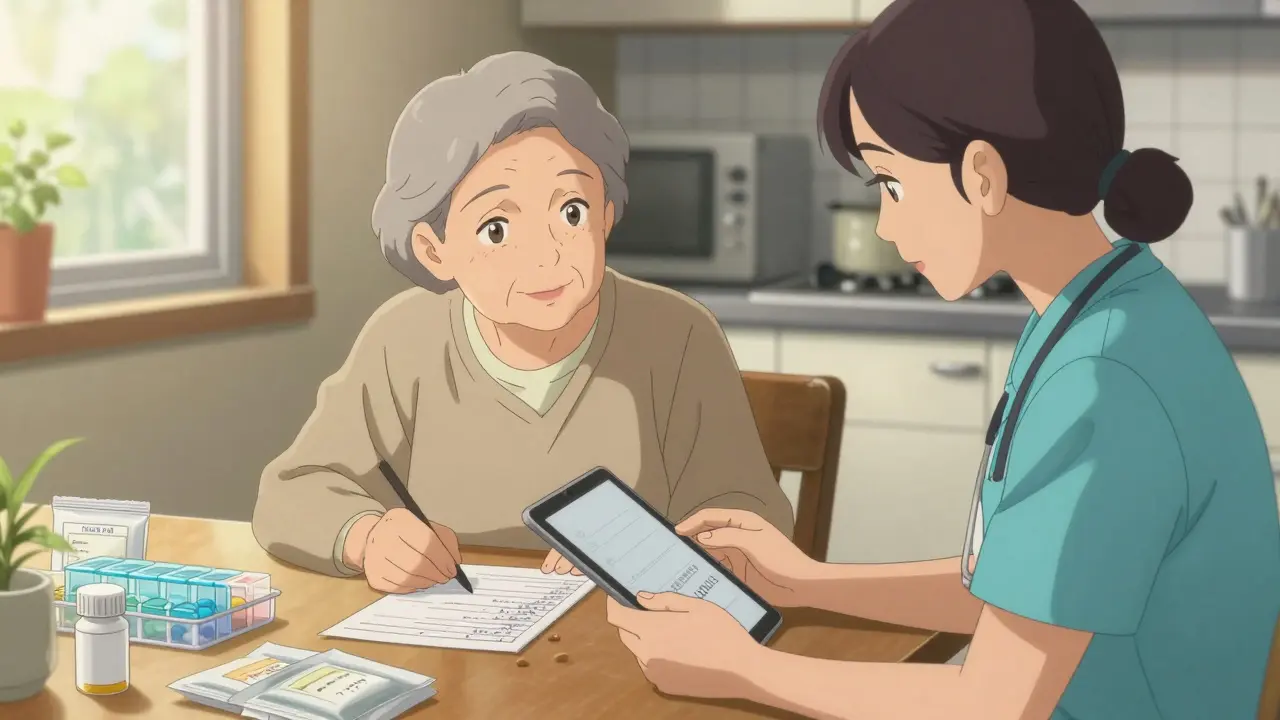
Managing medications at home isn’t just about popping pills on time. For seniors taking five, ten, or even more prescriptions daily, it’s a high-stakes routine where one missed dose or wrong combination can lead to hospital visits, dangerous side effects, or worse. Home health services step in to make this manageable, safe, and reliable - but only if you know how to use them right.
What Home Health Services Do for Medication Management
Home health agencies don’t just drop off pills. They build a system around them. A trained nurse or medication aide visits your home to check what you’re taking, when, and why. They compare your current list against what your doctors prescribed. They look for duplicates, interactions, or drugs that shouldn’t be taken by someone your age. This process is called medication reconciliation, and it’s not optional - it’s required by federal rules for Medicare-certified agencies.
According to MedPro’s 2022 analysis, about 30% of all bad events in home care come from medication errors. That’s not a small risk. But when a professional manages it, those errors drop by 60%. For seniors on polypharmacy - five or more meds - this isn’t just helpful. It’s life-saving.
How to Get Started
You don’t need to figure this out alone. If you or a loved one has been discharged from the hospital, had a fall, or struggles to remember doses, ask your doctor for a referral to a Medicare-certified home health agency. Medicare Part A covers these services at no cost if you meet three basic conditions: you’re homebound, you need skilled nursing or therapy, and your doctor certifies it’s medically necessary.
Here’s what happens next:
- A nurse visits within 48 hours to review every pill, patch, inhaler, and injection you’re using.
- They create a written list - including brand names, generic names, doses, times, and why each one was prescribed.
- They check for conflicts with over-the-counter drugs, supplements, or even herbal teas.
- They set up a schedule that fits your daily routine, not the other way around.
This isn’t a one-time check. The nurse comes back weekly or biweekly to update the list, adjust for new prescriptions, and make sure you’re still taking everything correctly.
Tools That Make It Work
People think medication management is just about remembering. It’s not. It’s about systems.
Pill organizers are the most common tool. Studies show they cut errors by up to 45%. But not all are created equal. Look for ones with separate compartments for morning, afternoon, evening, and night. Some even have alarms built in.
Phoenix Home Care’s WellPack system takes this further. Instead of a plastic tray, they use pre-filled, labeled pouches for each day. Each pouch has your name, the date, and a list of meds inside. No guessing. No mixing. Just open and take.
Digital tools help too. Apps with alarms and reminders improve adherence by 35%. But for seniors who aren’t tech-savvy, simple solutions work better. A watch set to vibrate at 8 a.m. and 8 p.m. is more reliable than a smartphone app they never open.
And don’t overlook visual aids. Clarest’s 2023 survey found that 67% of caregivers said large-print charts in the patient’s preferred language made a huge difference. If English isn’t your first language, ask for materials in Spanish, Mandarin, Vietnamese - whatever you’re most comfortable with.
What to Watch Out For
Even the best systems can break down if communication fails.
One caregiver in Ohio told a story on Reddit: her mother was prescribed a blood thinner, but the home nurse didn’t know her primary care doctor had just changed the dose. The old dose was still being given. It led to internal bleeding and an ER trip. That happened because no one talked to each other.
That’s why you need a single point of contact. Ask your home health agency to assign one nurse as your main coordinator. Make sure they’re in direct contact with your doctor’s office, pharmacist, and any specialists. If a new prescription comes in, it should be flagged immediately - not just added to the pile.
Also, watch for scheduling conflicts. MedlinePlus found that 31% of caregivers struggle when meds need to be taken at odd hours - like 3 a.m. or right after breakfast. If a dose requires an empty stomach but you eat at 7 a.m., the nurse should adjust the time. Flexibility matters.
When It’s Not Covered
Medicare only pays for intermittent visits - usually 2-3 times a week. If you need daily help, you’re on your own.
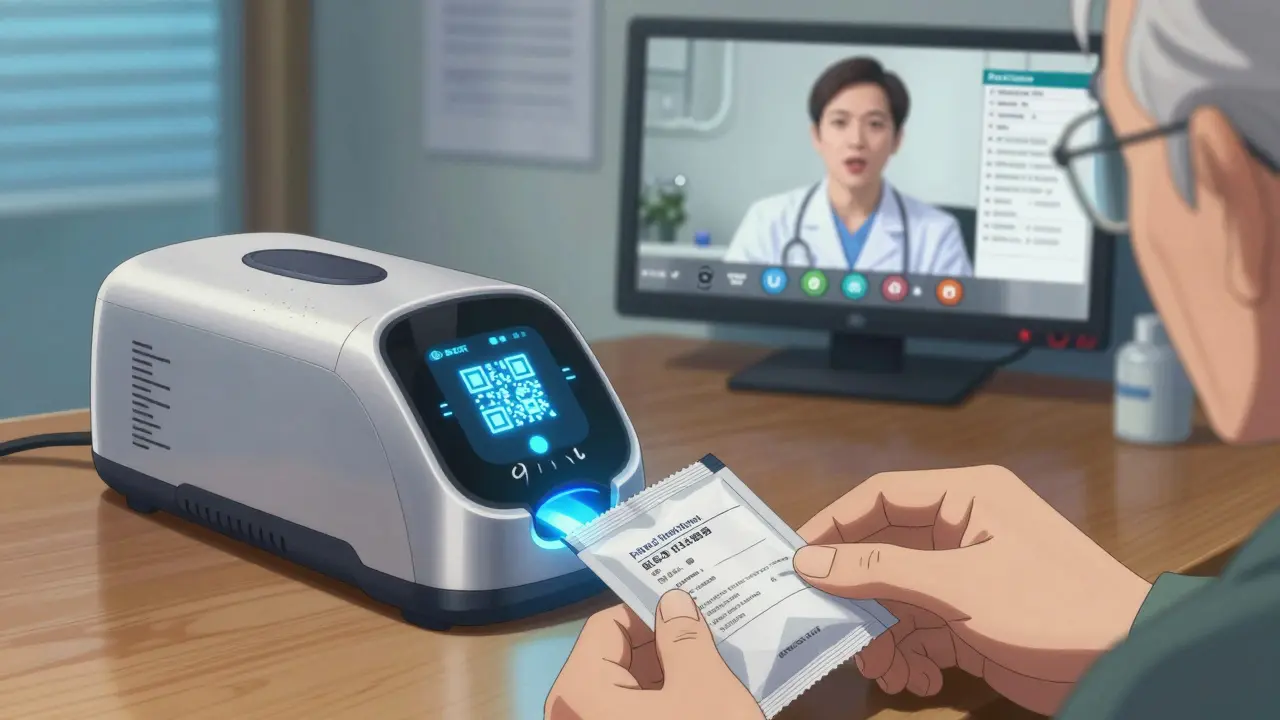
Private agencies like Clarest charge $20-$40 per hour for medication management. That adds up fast. But some Medicare Advantage plans now cover continuous monitoring devices - like smart pill dispensers that send alerts if a dose is missed. Ask your plan if they offer this.
Also, not all agencies do the same thing. Some only deliver pills. Others do full reconciliation, education, and documentation. Make sure you know what’s included before signing up.

What Professionals Look For
Home health nurses don’t just count pills. They use tools like the Beers Criteria - a list of medications that are risky for older adults. Common ones include certain sleep aids, antihistamines, and muscle relaxers. If you’re on any of these, they’ll flag it and talk to your doctor about safer options.
They also check for signs you’re not tolerating a med. Dizziness? Confusion? Falls? These aren’t just “part of aging.” They could be side effects. A good nurse will document these, not ignore them.
And they follow strict rules. Every change - even a new vitamin - must be written into your care plan within 24 hours. But here’s the catch: only 58% of agencies actually do this consistently. That’s why you need to keep your own copy of the list and update it yourself.
What You Can Do Right Now
You don’t have to wait for a referral. Start today:
- Gather every medication you take - pills, patches, eye drops, inhalers, even herbal supplements.
- Write down the name (brand and generic), dose, time, and why it was prescribed.
- Bring this list to your next doctor visit. Ask: “Are all of these still needed?”
- Ask if your doctor can send the list to a home health agency.
- Set up a daily alarm on your phone or watch for your most important doses.
Don’t wait for a crisis. If you’re taking more than three meds, professional help is worth it.
Why This Matters Long-Term
Clarest’s 2023 study found that seniors using home health medication services had 20% fewer hospital readmissions. That’s not just about avoiding discomfort - it’s about saving money. Each avoidable hospital stay costs around $1,200 per month in preventable expenses.
And it’s not getting easier. The home health market is growing fast. By 2027, it’ll be worth over $150 billion. More seniors are staying home. More meds are being prescribed. And more agencies are using tech - like QR codes that link to video instructions in 17 languages, or apps that scan your pill bottle to confirm you took it.
But the biggest threat isn’t cost or complexity. It’s staffing. One in four home health nurses is currently missing. That means longer wait times, fewer visits, and more pressure on families.
So if you’re considering this service, act now. Get your list ready. Talk to your doctor. Ask for help. The system works - if you use it right.
Can Medicare pay for daily medication management at home?
Medicare Part A covers home health services only if they’re intermittent - usually 2-3 times a week. It does not cover daily help. If you need daily medication support, you’ll need private pay, Medicaid (if eligible), or a Medicare Advantage plan that includes continuous monitoring devices. Some private agencies offer daily visits for $20-$40 per hour.
What’s the difference between a home health nurse and a home care aide?
A home health nurse is a licensed professional who can assess your condition, review medications, check for side effects, and communicate with your doctor. A home care aide helps with daily tasks like bathing or dressing, and may remind you to take pills - but they cannot adjust doses, check for interactions, or make clinical decisions. For medication management, you need a nurse.
How often should my medication list be updated?
Your list should be reviewed every time you see a new doctor, start a new medication, or stop one. Home health agencies are required to update it during every visit, but you should also keep your own copy and update it manually. If you change your pharmacy or doctor, bring the updated list with you.
Can home health services help with insulin or injections?
Yes. Home health nurses are trained to manage insulin, injections, IV medications, and other complex treatments. They’ll check your blood sugar, prepare the dose, and document everything. They can also teach family members how to assist if needed - but they won’t leave you completely dependent on others.
What should I do if I think a medication isn’t working or is causing side effects?
Don’t stop taking it. Write down the symptom - dizziness, nausea, rash, confusion - and when it happens. Tell your home health nurse immediately. They’ll document it, contact your doctor, and help determine if it’s a reaction or something else. Never adjust doses on your own, even if you think it’s too much.
Are there free tools to help track medications at home?
Yes. The CDC offers a free printable medication tracker you can download and use. Many pharmacies also provide free pill organizers. But the most effective tool is still a simple, handwritten list kept in a visible spot - like on the fridge or next to your coffee maker. The key isn’t the tool - it’s consistency.
Comments
tia novialiswati
I just started using home health services for my mom’s meds, and wow-what a game changer. 🙌 She’s on 8 pills and used to mix them up all the time. Now she has this cute little pill box with alarms, and the nurse comes twice a week to check in. She even helped us switch out a sleep aid that was making her dizzy. No more ER trips. I’m crying happy tears. You guys are doing amazing work. 💖
Dominic Punch
Let’s cut through the fluff. This isn’t ‘helpful’-it’s essential. If you’re over 65 and on more than three meds, you’re one missed dose away from a nightmare. The 60% reduction in errors? That’s not a stat-it’s a lifeline. Stop waiting for a crisis. Call your doctor today. No excuses. Your life isn’t a to-do list.
Valerie Letourneau
I appreciate the thoroughness of this piece. As a geriatric care coordinator in Ontario, I can confirm that medication reconciliation is one of the most underappreciated yet critical components of home-based care. The Beers Criteria should be mandatory reading for all providers. That said, systemic gaps persist-particularly around language accessibility and continuity of care between agencies and primary care. We need policy reform, not just individual solutions.
Khaya Street
I’ve been in home care for 12 years. The system’s broken. Nurses get paid peanuts, agencies cut corners, and families are left holding the bag. Yeah, the stats look good-but they’re cherry-picked. Most agencies don’t update logs within 24 hours. You think they’re checking interactions? Half the time they’re just handing out pills and running out the door. Don’t believe the hype.
Joseph Cantu
You know who’s really behind this? Big Pharma. They want you dependent on 10 pills so you keep buying them. The ‘medication reconciliation’? It’s a smoke screen. They’re not fixing the problem-they’re just making sure you don’t die before the next refill. And those ‘smart pill dispensers’? GPS trackers in disguise. Your meds are being monitored. Your movements. Your habits. Wake up. This isn’t healthcare. It’s surveillance.
Lisandra Lautert
Wrong. Medicare doesn’t cover daily management. Period. Stop pretending it does. If you need daily help, you’re paying out of pocket. No magic fix. No loophole. Stop wasting people’s time with feel-good stories. Facts matter.
Cory L
I had no idea about the WellPack system. Just ordered one for my dad. The pouches with his name and date? Genius. I’ve been using that CDC tracker printout, but honestly? It’s a mess. This looks like something that actually works. Also-vibrating watch > phone app. My uncle tried the app. He didn’t open it in six months. The watch? He wears it to bed. Simple wins.
Southern Indiana Paleontology Institute
Why are we letting some nurse from some agency tell old folks what to take? My grandpa took his pills how he wanted. He lived to 94. No doctor, no nurse, no fancy box. Just grit. You people are turning aging into a corporate product. Take responsibility. Your body. Your pills. Your life. Stop outsourcing your autonomy.
Anil bhardwaj
In India, we don’t have home health nurses like this. Elders take pills with chai, on the floor, sometimes forgetting if it’s morning or night. But we have family. Always someone there. Maybe that’s the real system-not the tech, not the app. Just someone who cares enough to sit with them.
lela izzani
I just want to say thank you for mentioning language accessibility. My grandmother speaks only Tagalog, and we struggled for months finding materials in her language. When the agency finally provided her instructions in Tagalog, she cried. It wasn’t just about pills-it was about dignity. Please, everyone: ask for translations. It’s not extra. It’s essential.
Joanna Reyes
I’ve been doing this for my mom for three years now, and honestly? The biggest issue isn’t the meds-it’s the communication breakdown between the home nurse, the pharmacist, and the doctor. I’ve had three different nurses over the past year, and each one had a different version of her med list. I keep a laminated copy on the fridge, updated every time we see a doctor. I even color-code them: red for blood thinners, blue for heart meds, green for vitamins. It’s ridiculous how little coordination there is. I’m not a nurse. I shouldn’t have to be the one holding it all together.
Stephen Archbold
Big love for the vibrating watch tip. My aunt tried the app, the pill box, the charts... nothing stuck. Then I got her one of those cheap fitness watches, set it to vibrate at 8 and 8. She doesn’t even know what ‘meds’ means anymore-but she knows when the watch buzzes. She takes it. Simple. Human. Works. Also, thanks for the Beers Criteria mention. That’s gold.
Nerina Devi
I work with seniors in rural India, and what you said about cultural context is so true. We don’t have home health nurses, but we have neighbors, temple volunteers, local pharmacists who know everyone’s routine. One woman takes her pills after she finishes her morning prayer. That’s her rhythm. You can’t force a 9 a.m. schedule on someone who wakes at 5 and prays for an hour. The system has to bend-not the person.
Spenser Bickett
Ah yes, the classic ‘professional help is life-saving’ narrative. Tell that to the 58% of agencies that don’t update logs. Tell that to the nurse who forgot to tell the doctor about the new blood thinner. Tell that to the family who paid $3000 for a ‘comprehensive service’ that just delivered pills once a week. This isn’t care. It’s a business model dressed in scrubs. You’re not saving lives-you’re monetizing vulnerability.