
Kidney Protection Hydration Calculator
Personalized Hydration Plan Tool
Determine if you need hydration before a CT scan with contrast based on your kidney function and risk factors. This tool helps you understand if oral hydration, IV fluids, or no special hydration is appropriate for your situation.
* Weight is required for IV fluid calculation
Your Personalized Hydration Plan
* This tool provides general guidance only. Always consult your physician for personalized medical advice.
** eGFR values below 60 indicate chronic kidney disease and increase risk of contrast-induced kidney injury.
When you’re scheduled for a CT scan, angiogram, or other imaging test that uses contrast dye, most people worry about the needle or the claustrophobia. But few think about how that dye might affect their kidneys-until it’s too late. Every year, millions of people get contrast dye for medical imaging, and while it’s lifesaving for diagnosis, it can also cause contrast-induced acute kidney injury (CI-AKI). This isn’t rare. It’s one of the most common causes of hospital-acquired kidney damage. The good news? You can often prevent it-not with a new drug, but with something simple: the right amount of fluid, at the right time.
What Is Contrast-Induced Kidney Injury?
CI-AKI happens when the kidneys can’t handle the stress of contrast dye. The dye temporarily reduces blood flow to the kidneys and can cause tiny tubules to get clogged or damaged. It’s not always obvious. You might feel fine afterward. But your blood tests will show a spike in creatinine-usually within 48 to 72 hours after the procedure. A rise of just 0.5 mg/dL or 25% above your baseline is enough to count as kidney injury.
This isn’t just a lab number. CI-AKI means longer hospital stays-on average, 3.2 extra days-and adds about $7,500 to your medical bill. For someone with existing kidney problems, it can push them toward dialysis or permanent damage. That’s why preventing it isn’t optional. It’s standard care.
Who’s at Risk?
Not everyone needs a hydration plan. But if you have any of these, you’re in the high-risk group:
- Chronic kidney disease (eGFR below 60 mL/min/1.73m²)
- Diabetes, especially with kidney involvement
- Heart failure or reduced ejection fraction
- Age over 75
- Dehydration or low blood volume
Here’s the key: if your eGFR is above 60 and you’re otherwise healthy, you likely don’t need aggressive hydration. Studies show no real difference in kidney injury rates between people who drank extra water and those who didn’t. But if your eGFR is below 60-or worse, below 30-you’re in the danger zone. That’s where hydration plans make the biggest difference.
The Standard Hydration Protocol
The most common method is intravenous (IV) saline. It’s simple, cheap, and widely available. The standard plan: give 0.9% sodium chloride (normal saline) at 3 to 4 mL per kilogram of body weight per hour. Start 4 hours before the contrast dye and keep going for 4 hours after.
For a 70 kg person, that’s about 210 to 280 mL per hour. Over 8 hours, that’s roughly 1.7 to 2.2 liters of fluid. It sounds like a lot, but it’s designed to flush the dye out before it can settle in the kidneys.
This approach cuts CI-AKI risk by about 26% compared to no hydration at all. That’s solid. But it’s not the best you can do.
Advanced Hydration: What Works Better
Over the past decade, research has shown that not all hydration is equal. Some methods do significantly better than standard saline.
Sodium bicarbonate is one alternative. Instead of plain saline, you use a solution that’s slightly alkaline. The theory? It reduces oxidative stress in kidney cells. Studies show it cuts CI-AKI risk by 26% too-but it’s not better than saline. Just about the same.
Then there’s hemodynamic-guided hydration. This is where things get smart. Instead of giving a fixed amount of fluid, doctors monitor your blood pressure, heart rate, and central venous pressure. They adjust the drip rate in real time to keep your kidneys perfused without overloading your heart. This approach reduces CI-AKI by 59%. That’s nearly two-thirds less risk.
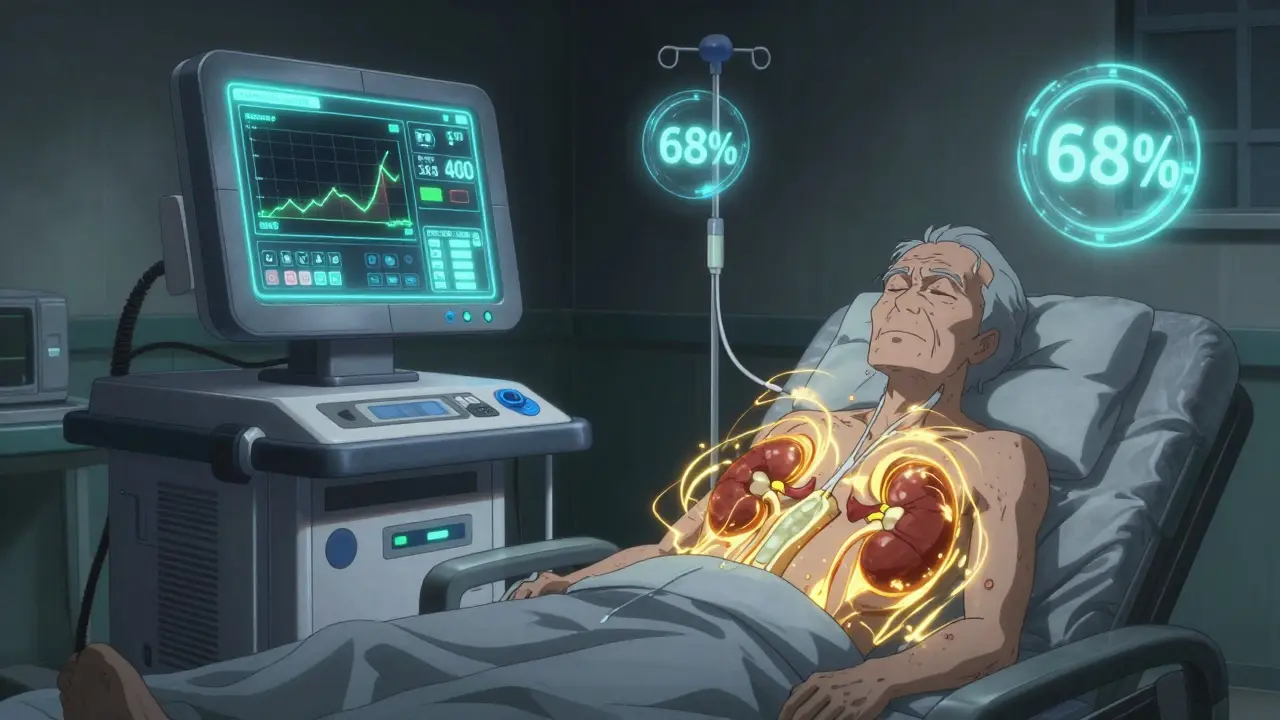
And then there’s the RenalGuard system. This isn’t just a drip. It’s a closed-loop machine. It measures your urine output every 15 minutes and automatically adjusts IV fluids to keep you peeing at 150-200 mL per hour. Why? Because keeping urine flowing prevents dye from concentrating in the kidney tubules. In high-risk patients, this system slashed CI-AKI from 22% down to just 7.3%. That’s a 68% reduction. The highest success rate of any method studied.
But RenalGuard isn’t in every hospital. It costs about $1,200 more per procedure. It needs special training. It’s not for every patient. But for someone with stage 3 or 4 kidney disease, it’s often the safest choice.
Oral Hydration: Can You Just Drink Water?
You don’t always need an IV. If you’re not in heart failure, not vomiting, and not too sick to drink, oral hydration works just as well.
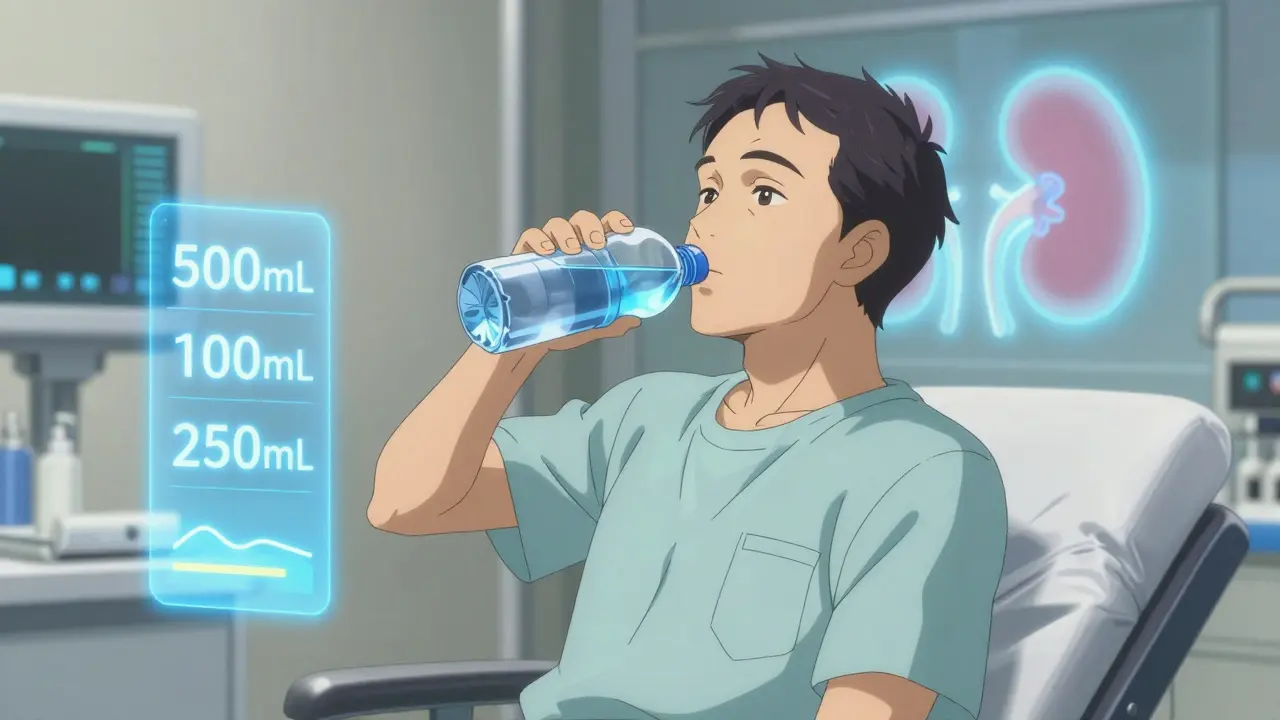
The protocol? Drink 500 mL of water two hours before the procedure, then 250 mL every hour during and after. Studies show this matches IV hydration in preventing kidney injury. In one trial, 4.7% of people who drank water got CI-AKI. 5.1% of those who got IV saline did. No difference.
This is huge for outpatient clinics and rural hospitals without IV resources. It’s also easier on patients. No needles. No IV pole. No being stuck in a chair for hours. Just drink water. Simple.
But here’s the catch: if you’re elderly, confused, or have trouble swallowing, oral hydration fails. You need IV.
Who Should Skip Hydration?
Not everyone needs it. If your eGFR is above 29 mL/min/1.73m² and you’re having an elective procedure, recent research says you can skip prophylactic hydration. The risk of kidney injury is so low-around 1.8%-that the downsides (cost, time, fluid overload) outweigh the benefits.
That’s a big shift. For years, doctors gave hydration to everyone who got contrast. Now, we’re learning to be more precise. It’s not about being lazy. It’s about avoiding unnecessary treatment. Overhydration can be dangerous too-especially if you have heart failure. Too much fluid can cause pulmonary edema. Even 500 mL extra can trigger breathing trouble in someone with a weak heart.
Implementation Challenges
Even the best plan fails if it’s not done right.
- Scheduling: A 12-hour hydration protocol means patients stay overnight. That’s costly and inconvenient.
- Monitoring: RenalGuard and hemodynamic systems need trained staff. Not every nurse knows how to use them.
- Documentation: You need baseline creatinine within 30 days. You need fluid intake/output logs. You need a follow-up creatinine at 48-72 hours. If any piece is missing, the plan isn’t complete.
One hospital in the U.S. cut its CI-AKI rate from 12.3% to 5.7% in a year-just by standardizing hydration protocols across cardiology, radiology, and nursing. It wasn’t expensive. It was systematic.
What’s Next?
The future of hydration isn’t just about more fluid. It’s about smarter fluid.
By 2025, the VA/DOD guidelines recommend using real-time biomarkers-like NGAL or cystatin C-to detect early kidney stress. These markers rise within hours of injury, long before creatinine does. Imagine a system that adjusts hydration based on your body’s real-time signals, not just fixed time windows.
And AI is coming. Early pilot programs at Johns Hopkins are testing algorithms that predict who will develop CI-AKI based on age, eGFR, diabetes status, and even the type of contrast used. The goal? Personalized hydration plans-right amount, right time, right patient.
For now, stick with what works: assess your kidney function, match the hydration to your risk, and don’t overdo it. Drink water if you can. Get IV if you need to. And if you’re high-risk, ask if RenalGuard or hemodynamic-guided hydration is available.
Bottom Line
Hydration isn’t magic. But it’s one of the most effective, low-cost ways to protect your kidneys from damage caused by medical imaging. The key is matching the plan to the person. No one-size-fits-all. No blanket rules. Just smart, individualized care.
If you’re scheduled for a scan with contrast, ask your doctor: "What’s my eGFR? Do I need IV fluids, or is water enough?" That simple question could save your kidneys.
Do I need to drink water before a CT scan with contrast?
Yes-if you’re at risk for kidney injury. If your eGFR is below 60 mL/min/1.73m², drinking water (500 mL two hours before, then 250 mL per hour) is just as effective as IV fluids. If you’re healthy with normal kidney function, you don’t need extra water. Always check with your doctor.
Is IV hydration always better than drinking water?
No. For most people with normal or mildly reduced kidney function, oral hydration works just as well. IV is only necessary if you’re dehydrated, nauseated, have heart failure, or your doctor needs precise control over fluid balance. For high-risk patients with severe kidney disease, IV is safer and more reliable.
Can hydration prevent kidney damage from all nephrotoxic drugs?
Hydration helps most with contrast dye, but it’s not a universal fix. For drugs like certain antibiotics (vancomycin, aminoglycosides), chemotherapy agents (cisplatin), or NSAIDs, hydration may reduce risk-but it doesn’t eliminate it. Other strategies like dose adjustment, avoiding combinations, or monitoring drug levels are also needed.
What’s the RenalGuard system, and is it worth it?
RenalGuard is a machine that automatically adjusts IV fluids based on your urine output. It keeps your kidneys flushed with just enough fluid to prevent damage without overloading your heart. It reduces CI-AKI by 68% in high-risk patients-better than any other method. But it costs more, needs training, and isn’t available everywhere. For patients with stage 3-4 kidney disease, it’s often the best option.
Can hydration cause harm?
Yes. Too much fluid can cause swelling, high blood pressure, or even heart failure, especially in people with weak hearts. That’s why hydration plans must be tailored. A 70-year-old with heart disease might need only 1 mL/kg/hour, not 4 mL/kg/hour. Doctors now use hemodynamic monitoring to avoid overhydration.
How long after a procedure should I get my kidney function checked?
Your creatinine should be checked 48 to 72 hours after the contrast procedure. That’s when kidney injury, if it’s going to happen, becomes detectable. Don’t assume you’re fine just because you feel okay. A blood test is the only way to know.
Does N-acetylcysteine (NAC) help protect kidneys from contrast dye?
No. Multiple studies, including a major 2020 meta-analysis, found that NAC doesn’t reduce CI-AKI when used with proper hydration. It was once popular, but current guidelines no longer recommend it. Stick to fluids-not supplements.
If you’re managing chronic kidney disease or have diabetes, talk to your doctor about your next imaging test. Don’t wait until after the scan to ask questions. Prevention starts before the needle goes in.
Comments
Dan Alatepe
Okay but imagine your kidneys are like a tiny, overworked barista who just got handed 10 extra espresso shots after already pulling 50 all morning. 😩 That’s what contrast dye does. And hydration? It’s like handing them a giant jug of water to rinse the machine before it explodes. I’m not a doctor, but I’ve seen my grandma’s creatinine spike after a scan-no hydration, no warning. Now I make sure she drinks like she’s training for a marathon. 🥤💪
Angela Spagnolo
Wow. This is... so important. I had no idea. I mean, I’ve had like 3 CTs and never once was anyone like, ‘Hey, drink water.’ I just thought it was all about the radiation. I’m gonna print this out and give it to my mom. She’s got diabetes and CKD. Thank you. Seriously. 🙏
Kuldipsinh Rathod
My uncle in Mumbai got CI-AKI after a CT. He was 78, diabetic, and they didn’t hydrate him because ‘he’s old, he won’t drink.’ He ended up on dialysis for 3 months. This post saved my life-literally. I made sure my dad’s next scan had hydration planned. Simple, cheap, effective. Why isn’t this standard everywhere?
SHAKTI BHARDWAJ
OH MY GOD. So all this time I’ve been drinking water like a normal person and they’ve been giving me IVs like I’m a dying horse?? I’m so mad. I had 3 scans and they pumped me full of saline like I was a soda machine. And now you’re telling me I could’ve just drunk tea and been fine?? I feel so used. And now I’m mad at my doctor. Like, why didn’t anyone tell me this??
Matthew Ingersoll
In the U.S., we treat hydration like a luxury, not a medical protocol. In rural India, people drink water before scans because they have no choice. But here? We need a $1,200 machine to prove we can hydrate someone. The system is broken. We’re spending billions on tech while ignoring the simplest, most effective intervention. This isn’t innovation-it’s negligence dressed up as progress.
Alex Ragen
One must interrogate the epistemological foundations of ‘hydration as prophylaxis.’ Is it not merely a placebo effect masked by statistical noise? The RenalGuard system, while technologically elegant, still operates under the Cartesian assumption that fluid volume alone governs renal perfusion. But what of microcirculatory dysfunction? What of endothelial glycocalyx degradation? The reductionist model of ‘flush it out’ ignores the phenomenology of renal stress. A true solution lies not in volume, but in ontological alignment between patient and physiology.
Lori Anne Franklin
I just had a CT last week and I drank water like the article said-500ml before, then sipping every hour. I felt great! No needles, no IV pole, just me and my water bottle. I’m telling all my friends. It’s so simple, why do hospitals make it so complicated?? Also, my nurse didn’t even mention hydration. I had to ask. So weird.
Bryan Woods
Based on the data presented, the most clinically significant finding is the 68% reduction in CI-AKI with RenalGuard in high-risk patients. The cost-benefit analysis is compelling when weighed against extended hospitalization and dialysis costs. However, scalability remains a challenge. Institutional adoption requires standardized protocols, staff training, and documentation integrity. Without these, even the most effective tool fails. System-level change is the real bottleneck.
Ryan Cheng
Hey everyone-this is such a good post. I’m a nurse in a rural clinic and we don’t have IVs for every patient. I’ve been telling folks to drink water before scans for years, but no one believed me. Now I’m printing this out and handing it to every patient with eGFR under 60. You’re not just saving kidneys-you’re saving people’s time, money, and peace of mind. Thank you for making this so clear.
wendy parrales fong
It’s so beautiful how something so simple-water-can be this powerful. We’re always chasing the next big drug, the fancy machine, the new pill. But sometimes, the answer is just… drink up. Like your body already knows what to do. You just have to listen. And give it what it needs. 🌊💛
Jeanette Jeffrey
Let’s be real. This is just corporate medicine repackaging ‘drink more water’ as a ‘protocol’ so they can charge for it. RenalGuard? $1200? You’re kidding me. My grandma drank tap water before her scans in the 80s and lived to 92. They’re just monetizing fear. Also, NAC was never useful. But hey, let’s sell you a machine instead of telling you to pee more.
Shreyash Gupta
Wait. So if I’m 35, no diabetes, eGFR 80, I don’t need water? But what if I’m dehydrated from drinking coffee all day? Or if I’m in a desert? Or if I’m Indian and my body’s used to less fluid? You can’t just say ‘eGFR above 60 = safe.’ That’s lazy science. Real life isn’t a textbook.
Ellie Stretshberry
My mom’s kidney function dropped after her scan and no one told her to drink. She was confused and tired for weeks. I wish I’d known this sooner. Now I’m making sure everyone in my family knows: if you’re getting contrast, drink water. It’s not optional. It’s basic care. Thank you for writing this. I’m sharing it with my whole group chat.
Zina Constantin
As someone who works in global health, I’ve seen this play out in clinics without running water. Hydration isn’t a luxury-it’s a human right. The fact that we have systems like RenalGuard in the U.S. while people in low-resource settings die from preventable CI-AKI is a moral failure. We need to push for low-cost, scalable hydration protocols worldwide-not just fancy machines for the privileged.
jesse chen
Just had to reply to the person who said NAC doesn’t work-I’ve been giving it to my patients for years based on old guidelines. I feel a little dumb now. But I’m glad we’re moving past it. This article is a wake-up call. I’m updating our hospital’s protocol tomorrow. Thank you for the clarity.