
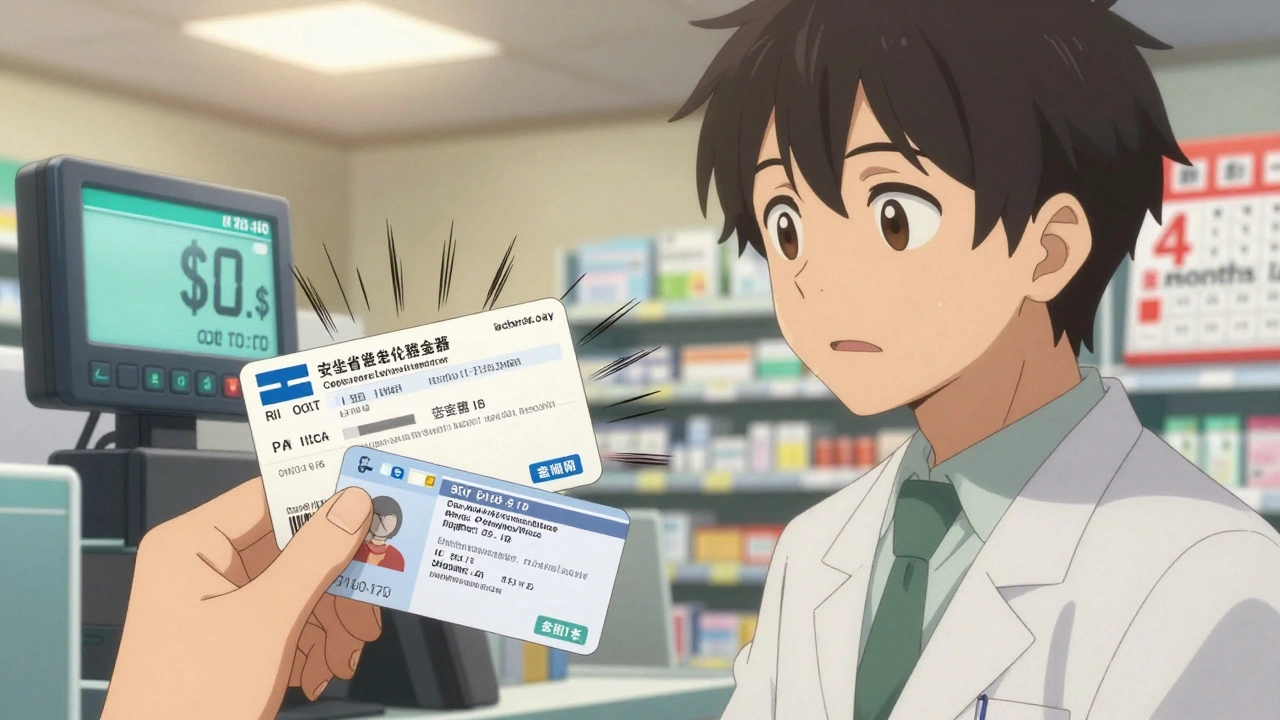
Brand-name medications can cost hundreds or even thousands of dollars a month. If you’re on private insurance and struggling to afford your prescription, a manufacturer copay assistance card might be your best option. These cards aren’t free money - they’re coupons issued by drug companies to help you pay your share. But if you don’t understand how they work, you could end up shocked when your bill suddenly jumps from $0 to $2,000 overnight.
What Exactly Is a Copay Assistance Card?
A manufacturer copay assistance card is a discount coupon provided directly by the pharmaceutical company that makes your brand-name drug. It doesn’t replace your insurance. Instead, it pays part or all of your copay or coinsurance - the amount you normally pay at the pharmacy after your insurance covers its share. These cards are only for people with private, commercial insurance. If you’re on Medicare Part D, Medicaid, or have no insurance, you can’t use them. That’s federal law. But if you’re covered by an employer plan, a plan from the health exchange, or even a spouse’s insurance, you’re likely eligible. The cards are mostly used for expensive, specialty drugs - things like biologics for rheumatoid arthritis, insulin for diabetes, or treatments for multiple sclerosis. Without help, these can cost $1,500 to $2,000 a month. With a card, your out-of-pocket cost might drop to $5 or $10. That’s life-changing.How Do You Get One?
Getting a card is simple. Go to the drug manufacturer’s website. Look for a section called “Patient Support,” “Savings Program,” or “Copay Assistance.” Enter your insurance info, confirm you’re not on Medicare, and download or print the card. Some sites even let you text or email a digital version to your phone. You don’t need a doctor’s note or proof of income. Just having commercial insurance is enough. Some cards require you to sign up once and they auto-renew. Others expire after a year and you have to reapply.How to Use It at the Pharmacy
When you pick up your prescription, hand the card to the pharmacist along with your insurance card. The pharmacy will scan both. The system will calculate your total cost. Your insurance pays its part. The manufacturer pays the rest - up to the limit on the card. The pharmacist will tell you your final price. If the card covers everything, you pay $0. If it only covers part, you pay the rest. The card doesn’t change your insurance’s coverage - it just fills the gap between what your plan pays and what you owe.The Hidden Trap: Copay Accumulator Programs
Here’s where most people get burned. Many insurance plans now use something called a copay accumulator program. This means the money the manufacturer pays with your card does not count toward your deductible or out-of-pocket maximum. Let’s say your drug costs $2,000 a month. Your card covers $1,990. You pay $10. Your insurance thinks you only paid $10. That $1,990 doesn’t move your deductible forward. So when your card runs out - maybe after 4 months - you’re suddenly responsible for the full $2,000. And you haven’t made any progress toward hitting your yearly out-of-pocket cap. This is not a glitch. It’s by design. Insurance companies introduced these programs to reduce how much they pay for expensive drugs. They figure: if the manufacturer is paying, why should we count it? But that leaves patients paying way more later. About 70% of commercial health plans in the U.S. use accumulators as of 2025. Some states - like California, Illinois, and New York - have passed laws banning them. But most haven’t. You have to check your plan.
Copay Maximizer vs. Accumulator: What’s the Difference?
There’s another version: the copay maximizer. This one works differently. Instead of ignoring the manufacturer payment, the insurer spreads it out evenly over the year. So if your card gives you $8,000 in annual help, and your monthly copay is $2,000, your plan might apply $667 toward your deductible each month. That means you still pay something every month, but your out-of-pocket costs are lower and your deductible moves forward. Maximizers are rarer than accumulators. But if you have one, your card is way more valuable long-term. The key is knowing which one your plan uses.How to Find Out If Your Plan Uses an Accumulator
Don’t guess. Call your insurance company’s member services number. Ask: “Does my plan use a copay accumulator or maximizer program for brand-name medications?” If they don’t know what you’re talking about, ask to speak to a benefits specialist. Say: “I’m on a manufacturer copay card. Will those payments count toward my deductible and out-of-pocket maximum?” You can also check your Summary of Benefits and Coverage (SBC) document. Look for terms like “copay accumulator,” “patient assistance program,” or “third-party payments.” If your plan uses an accumulator, you need a backup plan.What to Do When Your Card Runs Out
Most copay cards cap out at $5,000 to $8,000 per year. If you’re on a $2,000-a-month drug, that’s only 4 months of full coverage. Start planning at least 30 days before your card expires. Contact the drug manufacturer’s patient assistance program. Many offer free medication to low-income patients who qualify. You’ll need proof of income, but it’s often easier than you think. You can also check nonprofit organizations like the Patient Access Network Foundation (PAN) or the HealthWell Foundation. They give grants to help with copays for chronic conditions. Another option: switch to a pharmacy discount card like GoodRx or SingleCare. These aren’t tied to insurance. You can use them even if you’re on Medicare. They often offer lower prices than your insurance copay - especially for generics. But for specialty drugs, the manufacturer card still wins - if you can use it.
Manufacturer Cards vs. Pharmacy Discount Cards
| Feature | Manufacturer Copay Card | Pharmacy Discount Card | |--------|--------------------------|-------------------------| | Who issues it | Drug company | Third-party (GoodRx, SingleCare, etc.) | | Can you use it with Medicare? | No | Yes | | Can you use it without insurance? | No | Yes | | Best for | Expensive brand-name drugs | Generics and some brand-name drugs | | Annual limit | Usually $5,000-$8,000 | No limit, but prices vary | | Counts toward deductible? | Only if no accumulator | Doesn’t apply - no insurance involved | | How you get it | Manufacturer website | App or website | If you’re on Medicare or uninsured, discount cards are your only real option. If you have private insurance and need a specialty drug, the manufacturer card is usually better - unless your plan blocks it.Real-World Example: What Happens When the Card Ends
Sarah takes a biologic for lupus. It costs $2,100 a month. Her copay card covers $2,000. She pays $100. She thinks she’s saving $2,000 every month. After 4 months, her card runs out. She’s paid $400 total. But her deductible is still $0. Her out-of-pocket maximum is still $0. Her insurance has paid nothing toward her annual limit. Month 5: She’s billed $2,100. She has no more card. She didn’t know her plan uses an accumulator. She can’t afford it. She skips doses. Her symptoms flare. She ends up in the ER. Sarah didn’t fail. The system failed her.Pro Tips to Avoid the Trap
- Check your card’s annual limit. Write it down. Mark your calendar.
- Divide the limit by your monthly copay. That’s how many months you have.
- Call your insurer before you use the card. Confirm if it’s an accumulator.
- Set a reminder 30 days before your card expires. Start applying for other help.
- Keep a copy of your card and your plan’s policy in writing. Save emails from your insurer.
- Ask your pharmacist: “Is this card being processed correctly?” They see these issues daily.
Bottom Line
Manufacturer copay assistance cards can cut your drug costs in half - or more. But they’re not free. They’re a temporary lifeline. If you don’t plan for what comes after, you’ll pay the price. Know your plan. Know your limits. Know your alternatives. And never assume the card will keep working. The best way to save money on prescriptions isn’t just using a card - it’s understanding how the whole system works.Can I use a manufacturer copay card if I’m on Medicare?
No. Federal law prohibits using manufacturer copay cards with Medicare Part D. If you’re on Medicare, you can’t use these cards at all. Instead, use pharmacy discount cards like GoodRx or apply for patient assistance programs offered by the drug company or nonprofits.
Do copay cards count toward my deductible?
Only if your insurance plan doesn’t use a copay accumulator program. If your plan uses an accumulator, the manufacturer’s payment does not count toward your deductible or out-of-pocket maximum. This means you’ll still have to pay your full deductible even after using thousands in copay assistance. Always confirm your plan’s policy before relying on the card.
How do I know if my insurance has a copay accumulator?
Call your insurance company and ask directly: “Does my plan use a copay accumulator or maximizer program for brand-name medications?” If they’re unsure, ask to speak to a benefits specialist. You can also check your Summary of Benefits and Coverage (SBC) document for terms like “third-party payments” or “copay assistance.”
What if my copay card runs out and I can’t afford my drug?
Start looking for alternatives at least 30 days before your card expires. Contact the drug manufacturer’s patient assistance program - many offer free medication to those who qualify. You can also apply for help from nonprofits like PAN Foundation or HealthWell Foundation. Pharmacy discount cards like GoodRx may also offer lower cash prices than your insurance copay.
Are copay cards worth it if my plan has an accumulator?
They’re still worth it - but only for the months you have coverage. If you’re on a $2,000-a-month drug and your card covers $1,990, you’re saving $1,990 each month for the first 4-6 months. That’s thousands in savings. Just know that once the card ends, you’ll owe the full amount. Plan ahead so you’re not caught off guard.
Comments
dave nevogt
It’s staggering how the system is engineered to make you feel like you’re getting help while quietly setting you up for financial collapse. The manufacturer card isn’t charity-it’s a bait-and-switch with a fancy logo. You’re told ‘$0 copay!’ and your brain goes into survival mode, thinking you’ve won the lottery. But the accumulator? That’s the real villain. It’s not just a policy-it’s a structural betrayal. Insurance companies know exactly what they’re doing. They shift the burden from their balance sheets to your panic attacks. And the worst part? You don’t find out until your card expires and you’re staring at a $2,100 bill with no safety net. This isn’t about affordability. It’s about control. And we’re all just pawns in a game where the rules change mid-play.
People talk about ‘patient empowerment,’ but empowerment means knowing the trap before you walk into it. And most patients? They’re handed a card and told ‘good luck.’ No warnings. No fine print highlighted. Just a shiny coupon that vanishes when you need it most. We need transparency laws. Not just for insurers, but for manufacturers too. They should be required to print ‘This card does not count toward your deductible’ in bold red letters on the front. Not buried in a PDF.
I’ve seen people skip insulin because they didn’t know. I’ve seen people cry in pharmacy parking lots. This isn’t healthcare. It’s a maze with no exit unless you’re rich or lucky.
And don’t get me started on how pharmacies don’t even explain this. They scan the card, say ‘you owe $5,’ and move on. No follow-up. No ‘Hey, your card expires in 30 days.’ They’re not trained to care. They’re trained to process. And we’re the collateral damage.
It’s not just about money. It’s about dignity. When you’re forced to choose between your health and your rent, you stop being a patient. You become a statistic.
Someone needs to sue these companies. Not for fraud-because it’s legal-but for moral bankruptcy.
And until then? Keep asking questions. Keep documenting. Keep calling. Because if we don’t, no one will.
Rebecca M.
Oh sweet jesus, I’m so glad someone finally said this. I spent 6 months thinking I was a genius for getting my $2,000 drug for $10… until my card expired and my deductible was still at $0. I cried in the CVS parking lot. I literally cried. Like, full sobbing. My cat stared at me like I’d lost my mind. And then I realized-I had. Because I trusted the system. And it lied to me.
Now I keep a spreadsheet. Month by month. Card expiration. Deductible progress. Emergency contacts. I even color-coded it. Pink for ‘I’m gonna die if I don’t get this.’
Also, my pharmacist? She’s a saint. She texted me the day my card expired. I didn’t even ask. She just… knew.
God bless her. And god help the rest of us.
Zed theMartian
Oh, so now we’re pretending this is a ‘system failure’? Please. This is capitalism 101. You want cheap drugs? Then stop letting pharma companies profit off your desperation. The real problem? You’re all too happy to take a $10 coupon while letting the same companies charge $2,000 for a pill that cost $0.50 to make. You’re not victims-you’re enablers. If you didn’t buy it, they wouldn’t sell it. Simple.
And stop whining about accumulators. Insurance companies aren’t evil-they’re just responding to the absurdity of a system where a $10 copay is treated like a real payment. You want your ‘deductible credit’? Pay full price. Don’t let the manufacturer subsidize your laziness.
Also, GoodRx exists. Use it. Or get a job that pays more. Or move to Canada. But don’t act like you’re being persecuted because the free money ran out. There’s no free lunch. Only free delusion.
Jack Dao
Wow. Just wow. I can’t believe people still fall for this. You’re all acting like the drug companies are saints handing out gold bars. They’re not. They’re corporations. Their only goal is to keep you hooked on their $2,000/month drug so they can keep raking in billions. The card? A marketing tool. A distraction. A way to make you feel loyal to their brand.
And you’re all sitting here crying about accumulators like it’s a surprise? Newsflash: every contract has fine print. You didn’t read it. That’s on you. Not the system. Not the insurer. YOU.
Also, why are you still on brand-name drugs when generics exist? Oh right-because you’re too lazy to ask your doctor. Or because you believe the ads that say ‘this is the only one that works.’ Spoiler: it’s not. But you’d rather pay $2,000 than change your routine.
Stop playing the victim. Start thinking like an adult.
ATUL BHARDWAJ
Card helps now. Later problem. Call insurer. Ask. Write down. Save. Simple.
Many people forget. Not your fault. System bad. But you still can do something.
GoodRx. PAN. Help exists. Use it.
Stay calm. Plan ahead.
One day at a time.
Steve World Shopping
Let’s deconstruct this with a value chain lens. The manufacturer copay card is a downstream subsidy mechanism designed to mitigate price elasticity in high-margin specialty pharmaceuticals. The accumulator program is a cost-shifting mechanism aligned with the payer’s risk mitigation strategy, effectively externalizing the financial burden to the patient once the third-party subsidy is exhausted. This is not a failure-it’s a feature of the current healthcare financing architecture, where reimbursement incentives are misaligned with patient outcomes. The root cause? Fragmented payer-provider incentives and the absence of value-based contracting. Until we move toward outcomes-based pricing models, this will persist. Also, GoodRx is a Band-Aid. What we need is single-payer or at least price transparency regulation. But good luck getting Congress to act.
TL;DR: You’re not being scammed-you’re being optimized for profit.
Alicia Marks
You’re not alone. I’ve been there. Took me 3 months to figure out the accumulator thing. But I found help. PAN gave me $5k. My doctor helped me apply. Now I’m on a different drug that’s cheaper and works just as well. You can do this. One step at a time. Reach out. Ask. Someone will help. You’ve got this.
Lynn Steiner
My mom took that insulin for 12 years. Card worked for 8. Then it ended. She cried every night. Said she felt like a burden. I had to sell my car to cover 3 months. Now she’s on Medicare. Can’t use the card anymore. So we use GoodRx. It’s $180 a month now. Not perfect. But it’s something.
They don’t care. They just want your data. Your prescriptions. Your fear.
I hate this system.
And I’m not over it.
Arun kumar
bro this is so real. i had the same thing with my rheumatoid arthritis med. card gave me $0 for 5 months. then boom. $1800 bill. i thought i was smart. turns out i was dumb. called the company. they said ‘sorry, we can’t help anymore.’ then i found a local clinic that gave me free samples for 2 months. also used goodrx for the rest. its messy. but you survive. dont give up. its not you. its the system. we all in this together. peace.
Paul Keller
While the narrative presented here is emotionally compelling and statistically accurate, it fundamentally misunderstands the economic architecture of pharmaceutical pricing in the United States. The manufacturer copay card is not a benevolent gesture-it is a strategic instrument designed to circumvent formulary restrictions and maintain market share in the face of biosimilar competition. The copay accumulator, far from being an ethical lapse, is a rational response by payers to the artificial inflation of drug prices enabled by these very cards. When a manufacturer subsidizes a patient’s copay, it effectively reduces the price sensitivity of the consumer, allowing the drug company to maintain a higher list price without losing market share. This creates a perverse incentive structure where the patient’s out-of-pocket cost is minimized, but the total cost to the system is maximized. The solution is not to blame insurers or manufacturers, but to advocate for price transparency, direct negotiation of drug prices by payers, and the elimination of rebates that distort market dynamics. Until we address the root cause-the lack of price regulation-we are merely rearranging deck chairs on the Titanic. The card may offer temporary relief, but it perpetuates the very system that makes the drug unaffordable in the first place. The real heroism lies not in using the card, but in demanding systemic change.