
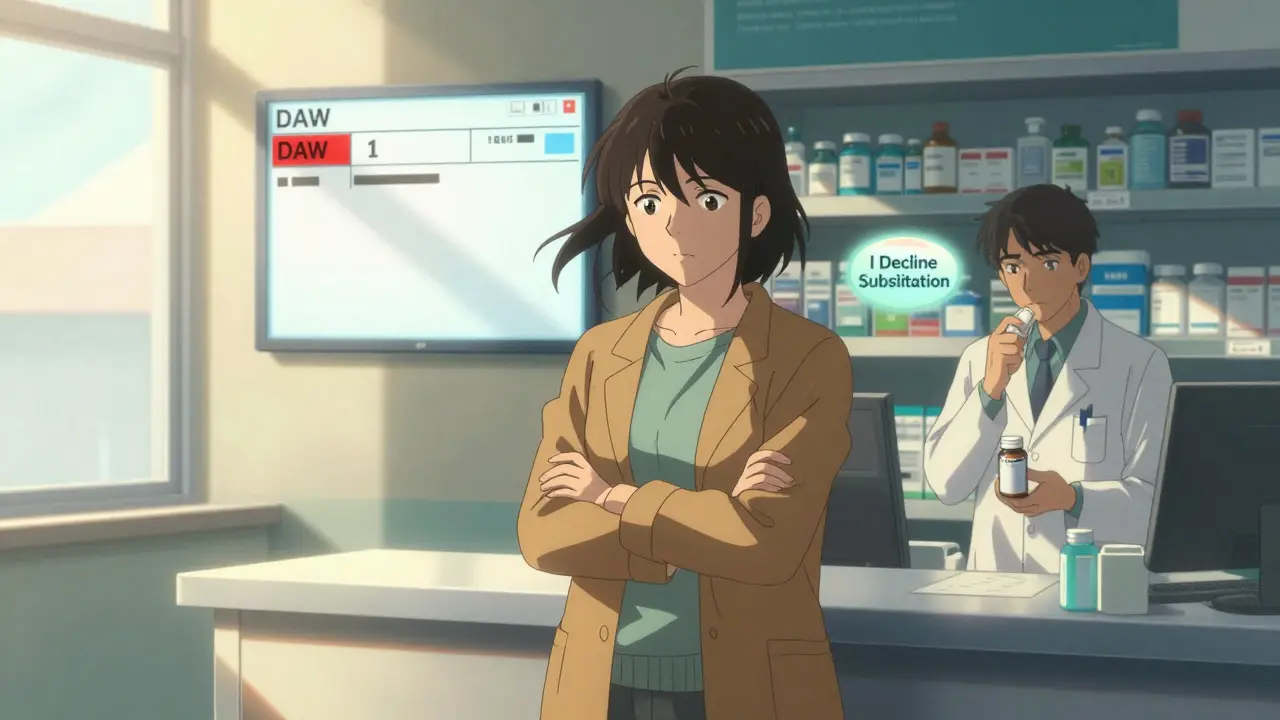
Every time you pick up a prescription, there’s a good chance the pharmacist hands you a generic version instead of the brand-name drug your doctor wrote on the script. It’s legal. It’s common. And in most cases, it’s safe. But what if you don’t want it? What if you’ve had bad reactions before? What if your doctor specifically prescribed the brand for a reason? You have a right to say no-and knowing how to exercise that right can make a real difference in your health.
Why Pharmacists Substitute Generics
Pharmacists don’t switch your medication out of spite. They do it because it saves money-for you, your insurer, and the system. Generic drugs are chemically identical to brand-name versions, but they cost 80-85% less. In 2023, generics made up 92% of all prescriptions filled in the U.S., yet accounted for only 24% of total drug spending. That’s billions in savings. Pharmacy benefit managers (PBMs) like CVS Caremark and Express Scripts push for substitution because it lowers their costs. Insurance plans often charge lower co-pays for generics. Even Medicare Part D plans have generic utilization rates above 95%. But here’s the catch: just because a generic is cheaper doesn’t mean it’s always the best choice for you.Your Legal Right to Refuse
You are not obligated to accept a generic substitution. Every state has laws about this-but they vary wildly. In 19 states, including California, Texas, and New York, pharmacists are required to substitute unless the doctor says otherwise. In 7 states-Alaska, Connecticut, Hawaii, Maine, Massachusetts, New Hampshire, and Vermont-plus Washington, D.C., the law says you must give explicit consent before the switch happens. That means if you don’t say yes, they can’t give you the generic. And in 31 states and D.C., pharmacists must notify you before substituting, even if they don’t need your permission. That notification can be verbal or written. If they don’t tell you, they’re breaking the law. The bottom line? You have the right to refuse. You don’t need to argue. You don’t need to prove anything. Just say, “I decline substitution,” and they’re legally required to honor it in 43 states.When Brand-Name Drugs Are Necessary
Not all drugs are created equal when it comes to substitution. Some have what’s called a narrow therapeutic index (NTI). That means the difference between a helpful dose and a dangerous one is tiny. Even small changes in how the drug is absorbed can cause serious side effects. Drugs like levothyroxine (for thyroid), warfarin (a blood thinner), and certain antiepileptic medications fall into this category. The FDA’s Orange Book lists therapeutic equivalence ratings. Drugs marked “A” are generally safe to swap. Drugs marked “B” are not. But even “A” drugs can cause problems if you’ve been stable on one brand for years. A 2019 Michigan case resulted in a lawsuit after a patient had a seizure following an automatic switch from a brand-name antiepileptic to a generic. The pharmacy lost. In another case, a patient on insulin switched to a biosimilar without being told-his blood sugar became erratic for weeks before he figured out what had changed. The World Medical Association says: once you’re stable on a medication, whether brand or generic, don’t switch without your doctor’s approval. That’s not just caution-it’s medical best practice.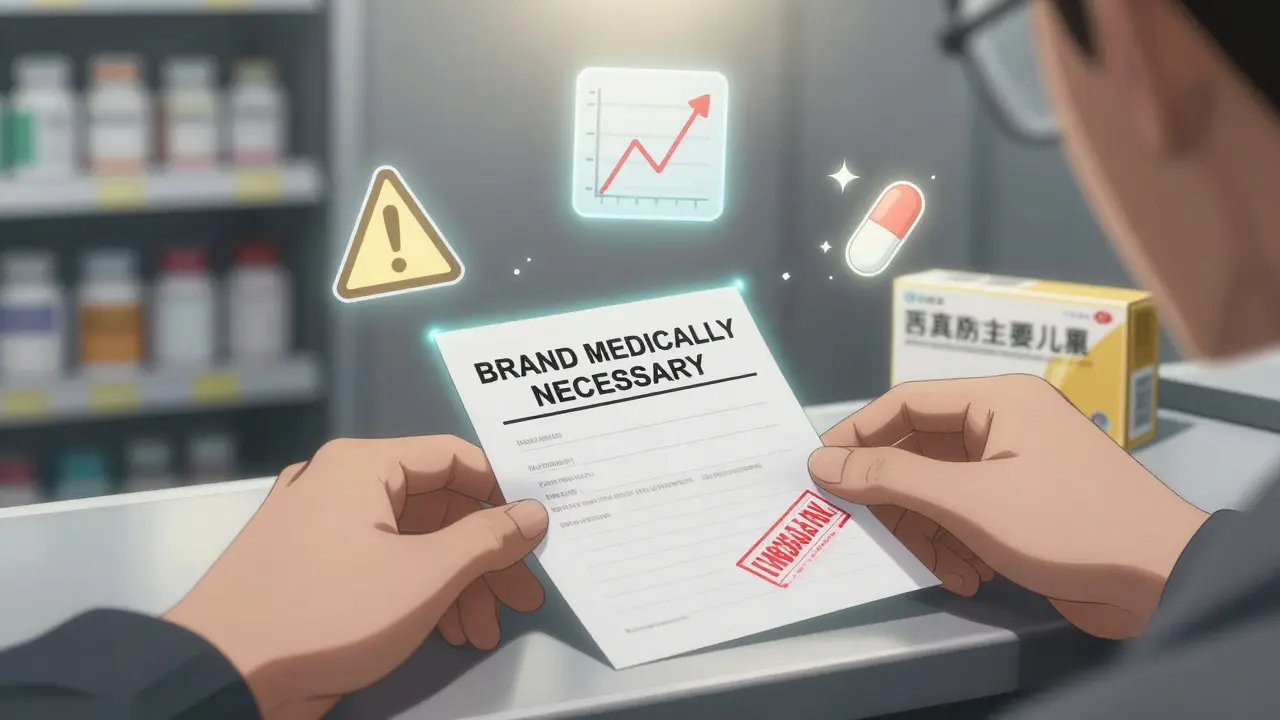
How to Say No-And Make It Stick
Saying “no” sounds simple. But pharmacists are under pressure. They’re trained to save money. Sometimes they’ll say, “I have to substitute,” or “It’s cheaper for you.” That’s not always true. In fact, under the 2018 Know the Lowest Price Act, pharmacists are now required to tell you if paying cash for the brand-name drug would cost less than your insurance co-pay. Here’s how to handle it:- Be clear and direct. At the counter, say: “I decline substitution.” No explanation needed. In 43 states, that’s legally sufficient.
- Ask for the brand-name drug. If they ask why, you can say: “My doctor prescribed this brand for a reason.”
- Request the pharmacy manager. If the pharmacist pushes back, ask to speak to someone in charge. They’re more likely to know the law.
- Know your state’s rules. If you live in Massachusetts, Hawaii, or Vermont, you have extra protection-you can’t be switched without your consent. Check your state pharmacy board’s website for specifics.
What to Do If You’re Pressured or Mistreated
Some patients report being told they’ll pay more if they refuse substitution. That’s misleading. In many cases, the cash price of the brand is lower than the insurance co-pay for the generic. Always ask: “What’s the cash price?” If a pharmacist refuses to honor your request, you have options:- Ask for a written explanation of why they’re overriding your request.
- File a complaint with your state’s Board of Pharmacy. Every state has a process-usually online and free.
- Report medication errors to the FDA’s MedWatch system. If a substitution caused harm, that’s important data.
- Talk to your doctor. They can send a new prescription with “Dispense as Written” (DAW) coded on it. Some states ban doctors from putting this on every script, but they can use it when medically needed.
Costs, Savings, and Hidden Trade-Offs
It’s easy to assume generics are always the better deal. But the real cost isn’t just the price tag. A 2022 Congressional Budget Office report found that non-medical switching-changing stable patients to generics without medical reason-costs the system $2.1 billion a year in extra doctor visits, ER trips, and lab tests. For patients, the savings on generics can be real: GoodRx found an average out-of-pocket savings of $27.50 per prescription. But if that switch triggers side effects, hospitalization, or loss of work, the cost skyrockets. And don’t forget: biosimilars aren’t generics. They’re complex biological drugs-like insulin or Humira-that mimic the original but aren’t identical. All 50 states let doctors block substitution for these, and 47 states now require pharmacists to notify the prescriber if they switch you. Still, many patients aren’t told. That’s a gap.What You Can Do Now
You don’t need to wait for a crisis to protect yourself. Here’s what to do today:- Check your last prescription: Was it switched? Did you know?
- Call your pharmacy and ask: “Do you automatically substitute generics?”
- Ask your doctor: “Is my medication one that should stay on brand?”
- Keep a list of any side effects you’ve had with generics. Bring it to every appointment.
- Save your receipts. If you paid more for the brand, you might be eligible for manufacturer assistance programs.
Refusing a substitution isn’t about being difficult. It’s about being in control of your own care. And that’s not just a right-it’s a necessity.
Can I refuse a generic drug at the pharmacy even if my insurance prefers it?
Yes. In 43 states, simply saying “I decline substitution” is legally enough to stop the switch. Your insurance may charge you more for the brand-name drug, but you still have the right to choose. In 7 states plus D.C., the pharmacist must get your explicit consent before switching-so if you don’t say yes, they can’t do it.
What if the pharmacist says they have to substitute?
That’s often false. In states requiring patient consent (like Massachusetts or Vermont), they absolutely cannot substitute without your approval. Even in states where substitution is allowed, they must notify you first. If they claim they’re forced to switch, ask to speak to the pharmacy manager. Most managers know the law better than front-line staff. If they still refuse, file a complaint with your state’s Board of Pharmacy.
Are generic drugs always safe to use?
For most people, yes. The FDA requires generics to meet the same standards as brand-name drugs. But for drugs with a narrow therapeutic index-like thyroid medication, blood thinners, or seizure drugs-even small differences in absorption can cause problems. If you’ve been stable on a brand-name drug for months or years, switching without medical oversight can be risky. Always talk to your doctor before agreeing to a switch.
Can my doctor prevent generic substitution?
Yes. Doctors can write “Dispense as Written” or “DAW 1” on the prescription, which legally blocks substitution in all states. In 48 states, they can also write “brand medically necessary,” which is a stronger form of protection. This is especially important for patients on chronic medications or those who’ve had bad reactions to generics in the past.
What if I can’t afford the brand-name drug?
You’re not alone. Many drug manufacturers offer patient assistance programs that provide brand-name medications at low or no cost. Ask your pharmacist or doctor for help applying. You can also use tools like GoodRx or NeedyMeds to compare cash prices. Sometimes, paying cash for the brand is cheaper than your insurance co-pay for the generic-especially after the 2018 law banned “gag clauses” that hid this information.
Next Steps for Patients
If you’re on a long-term medication, take 10 minutes now to protect yourself:- Check your last 3 prescriptions. Were any switched to generics without your knowledge?
- Call your pharmacy and ask if they notify patients before substituting.
- Ask your doctor: “Should I stay on brand for this medication?” Get it in writing if needed.
- Keep a note in your phone: “I decline substitution” - so you’re ready the next time you walk up to the counter.
Comments
Jasmine Yule
I decline substitution. Period. I don't care if it's 'chemically identical'-my body knows the difference. I had a seizure after they switched my antiepileptic. The pharmacy didn't even tell me. Now I carry a printed note in my wallet. No more guessing games.
They treat us like numbers. We're not cost centers. We're people with histories, side effects, and lives to live.
Stop normalizing this. If your doctor says brand, you get brand. Full stop.
Teresa Rodriguez leon
This is why I hate the healthcare system. They don’t care if you’re stable. They just want to save a buck. I’ve been on the same brand of levothyroxine for 12 years. Last month they swapped it without asking. I gained 18 pounds, couldn’t sleep, and felt like I was drowning in slow motion. No one apologized. No one even checked in. Just another cog in the machine.
Manan Pandya
Excellent breakdown. The legal landscape is indeed fragmented, but the core principle remains: patient autonomy trumps cost efficiency. The FDA’s therapeutic equivalence ratings are useful, but they don’t account for inter-individual pharmacokinetic variability. A 2017 study in the Journal of Clinical Pharmacology showed significant bioequivalence deviations in NTI drugs across generic manufacturers. It’s not about distrust-it’s about precision medicine.
Also, the 2018 KLP Act’s removal of gag clauses was a landmark. Always ask for the cash price. Often, the brand is cheaper than your co-pay after insurance markup.
Aliza Efraimov
OH MY GOD YES. I’ve been screaming this from the rooftops since my dad had a stroke because they switched his warfarin without telling him. He was fine for 3 years on Coumadin. Then they gave him a generic. INR went from 2.3 to 4.8 in 48 hours. He ended up in the ER with a brain bleed. The pharmacist said, ‘It’s the same thing.’
NO. IT’S NOT.
I now have a laminated card in my purse that says ‘I DECLINE SUBSTITUTION’ in bold letters. I hand it to every pharmacist. And I don’t care if they roll their eyes. My dad’s alive because I fought. You will too.
Also, GoodRx saved me $117 on my brand-name meds last month. Cash > insurance.
Nisha Marwaha
From a pharmacoeconomic standpoint, non-medical switching (NMS) represents a classic case of externalized costs. While the front-end savings are quantifiable via PBM contracts, the downstream utilization costs-ED visits, hospitalizations, lab monitoring, and provider time-are systematically underaccounted for in formulary decisions. The 2022 CBO report referenced is a critical data point: $2.1B in avoidable expenditures. Moreover, the lack of pharmacovigilance for generic bioequivalence in NTI classes remains a regulatory blind spot. The FDA’s Orange Book does not capture inter-batch variability, which is particularly relevant in sustained-release formulations. Clinicians must advocate for DAW 1 coding where appropriate, and patients should be empowered to request therapeutic drug monitoring post-switch.
Paige Shipe
So… you want to pay more? For what? So you can feel special? I get it, you think you’re different. But generics are FDA-approved. They’re not ‘inferior.’ You’re just being dramatic. My cousin takes generic metformin and is fine. You’re not entitled to brand-name drugs just because you’re ‘sensitive.’ The system is designed to help people. Not pamper them.
Also, your doctor doesn’t know everything. Maybe they just wrote it because they were lazy.
Tamar Dunlop
It is with profound gravity that I acknowledge the systemic erosion of patient agency within contemporary pharmaceutical practice. The commodification of health, driven by profit-centric intermediaries, has rendered the individual’s voice an afterthought. I have witnessed elderly patients in Toronto, many of whom are non-native English speakers, being coerced into substitutions without comprehension of the legal implications. The duty of care must transcend fiscal calculus. To refuse substitution is not an act of defiance-it is an assertion of human dignity. I implore all readers: educate, advocate, and never acquiesce to institutional indifference.
David Chase
AMERICA IS BEING RUINED BY PEOPLE WHO THINK THEY’RE SPECIAL!!!
GENERIC DRUGS ARE 99.9% THE SAME!!
YOU WANT BRAND? PAY FOR IT!!
STOP BEING A SNIVELING CRYBABY BECAUSE YOU DON’T WANT TO SAVE THE COUNTRY MONEY!!
MY DAD WAS A VET AND HE TOOK GENERIC ALL HIS LIFE AND NEVER HAD A PROBLEM!!
YOU’RE NOT A VICTIM. YOU’RE A COST CENTER!!
GET A JOB. STOP WHINING. AND STOP MAKING EVERYTHING ABOUT YOU!!
🇺🇸💪💊
Emma Duquemin
Y’ALL. I just called my pharmacy and asked if they notify patients before switching. They said ‘no, we just do it.’ I said ‘I’m not okay with that.’ They put me on hold for 12 minutes. Then the manager came on and said ‘ohhhhh we can do that, we just need you to sign this form.’ I signed it. Now my whole profile is flagged.
And guess what? My brand-name insulin costs $180 cash. My co-pay for the ‘generic’ was $205. I saved $25. And I didn’t have to risk my life.
So yeah. Ask for the cash price. Ask for the manager. Ask for your rights. And if they give you side-eye? Smile. Say ‘thank you for your service’ and walk out. Then file a complaint. They hate that part.
Also-GoodRx is your BFF. Download it. Live by it. Love it.
Kevin Lopez
NTI drugs. DAW 1. Bioequivalence variance. PBM incentives. Regulatory gaps. All valid. But most patients don’t need brand. Most don’t even know what NTI means. This post is over-engineered. Just say ‘no’ if you’re one of the 5% who actually need it. Don’t turn it into a movement. Most of you are fine with generics. Stop pretending you’re special.
Himanshu Singh
Hey everyone, i just wanted to say thanks for this post! I had no idea i had the right to refuse! I just thought pharmacists always did what they wanted. I just called my pharmacy and asked if they switch my meds automatically-they said yes. So i told them i dont want that anymore. They were kinda surprised but said they’ll update my file. I feel so much better now! 🙌
Also, i found out my brand name med is cheaper cash than my copay! i had no idea!! 😅
Greg Quinn
It’s interesting how we treat medication like a product, not a part of our biology. We don’t argue about the brand of our shoes or our toothpaste-but we’re supposed to be fine with our brain chemistry being swapped out like a lightbulb?
Maybe the real issue isn’t the generics. It’s that we’ve outsourced our health to systems that see bodies as line items. I’m not against savings. I’m against erasing individuality in the name of efficiency.
Also, I just asked my pharmacist what the cash price was. He looked at me like I’d asked for a unicorn. Then he checked. The brand was $17 cheaper. I paid cash. He didn’t say a word.
Lisa Dore
Guys, I’m not a doctor, but I’ve been helping my mom navigate her meds for 8 years. She’s on 12 prescriptions. Half of them got switched without her knowing. She didn’t even realize she felt worse until I sat down with her and said ‘what’s different?’
So now we have a spreadsheet. Medication. Brand. Generic. Date switched. Side effects. Notes. We bring it to every appointment. I told my mom: ‘You’re not being difficult. You’re being smart.’
And if you’re scared to ask? Just say ‘I’m keeping a health journal.’ They’ll back off. Trust me.
You’re not alone. We’ve got this.
Sharleen Luciano
How quaint. You think your personal anecdote about a ‘bad reaction’ justifies circumventing a $2.1 billion cost-saving mechanism? The FDA’s bioequivalence standards are among the most rigorous in the world. Your ‘stability’ is a placebo effect. You’re not a medical pioneer-you’re a privilege-seeking consumer who doesn’t understand economies of scale.
And let’s be honest: if you could afford the brand, you wouldn’t be on insurance in the first place.
Stop romanticizing your ‘right’ to waste resources. The system works for 99% of people. Don’t be the 1% who breaks it.
Duncan Careless
Thank you for this. As someone who works in a pharmacy in rural Scotland, I see this every day. Patients are terrified to speak up. They think we’re being cruel when we switch. We’re not-we’re just following protocols. But the truth? Many of us want to do better. We just don’t have the time or training to explain the law.
One patient last week said ‘I decline substitution’ and I nearly cried. I hadn’t heard that in 10 years. I handed her the brand. She hugged me. No one had ever done that before.
It’s not about money. It’s about respect.