
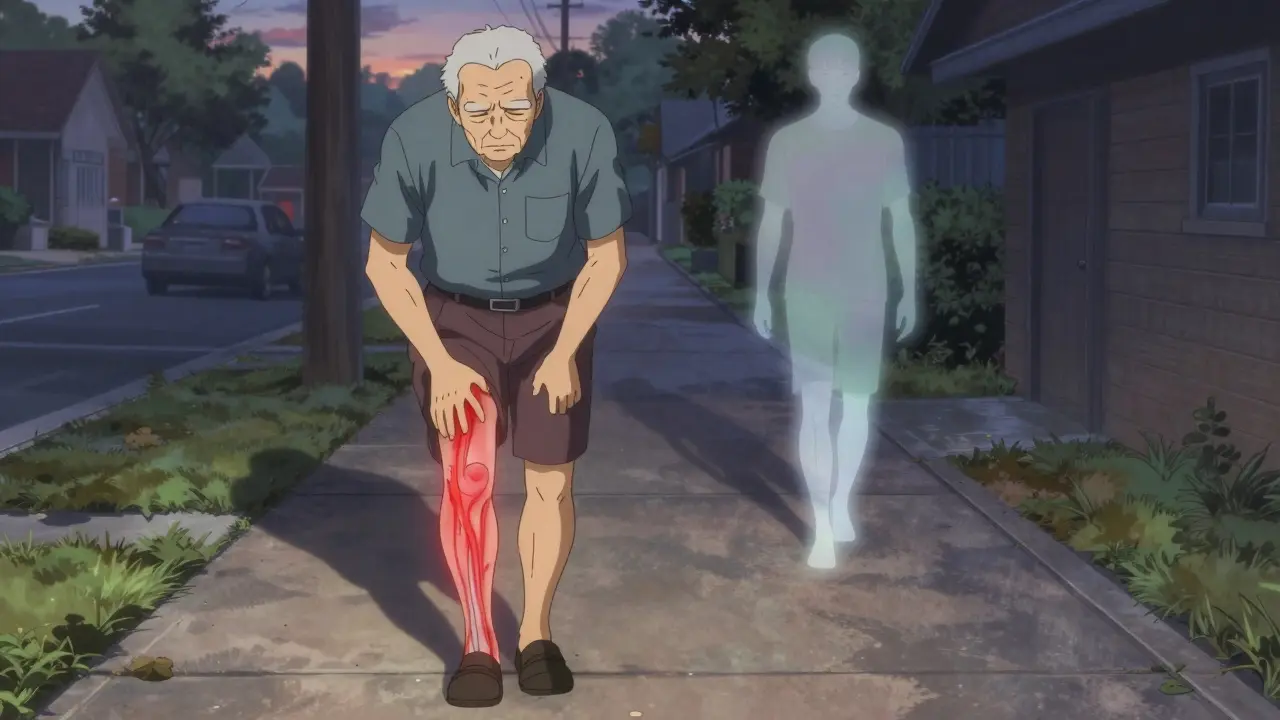
Peripheral artery disease, or PAD, isn't just a slow circulation problem-it's a warning sign that your entire vascular system is under stress. Many people ignore the early signs, thinking it's just aging or being out of shape. But when your legs start hurting after walking just a few blocks, or your toes won't heal a small cut, that's not normal. PAD affects about 8.5 million Americans, and up to 20% of people over 65 have it. The truth? Most of them don't even know it.
What PAD Really Feels Like
The classic symptom is claudication: a cramp, ache, or tired feeling in your calves, thighs, or hips that shows up when you walk or climb stairs and goes away with rest. It's not just muscle fatigue-it's your muscles screaming because they're not getting enough oxygen-rich blood. About 10% of people with PAD experience this clearly. The rest? They might just feel like they're getting slower, or they stop walking because it's uncomfortable.
But PAD doesn't stop at leg pain. Look at your feet. Is the skin unusually shiny? Are your toenails thickening or stopping growth? Is there less hair on your legs than before? These aren't just cosmetic changes-they're signs your arteries are narrowing. In more advanced cases, you might feel pain even when you're lying down, especially at night. That's critical limb ischemia, and it means tissue is dying. If you have a sore on your foot that won't heal after weeks, that’s an emergency.
Men with PAD often have erectile dysfunction. It sounds unrelated, but it’s not. The same arteries that supply blood to your legs also supply blood to your genitals. If one is clogged, others likely are too. Studies show 45% to 75% of men with PAD have sexual dysfunction, often before leg symptoms appear.
How Doctors Find PAD
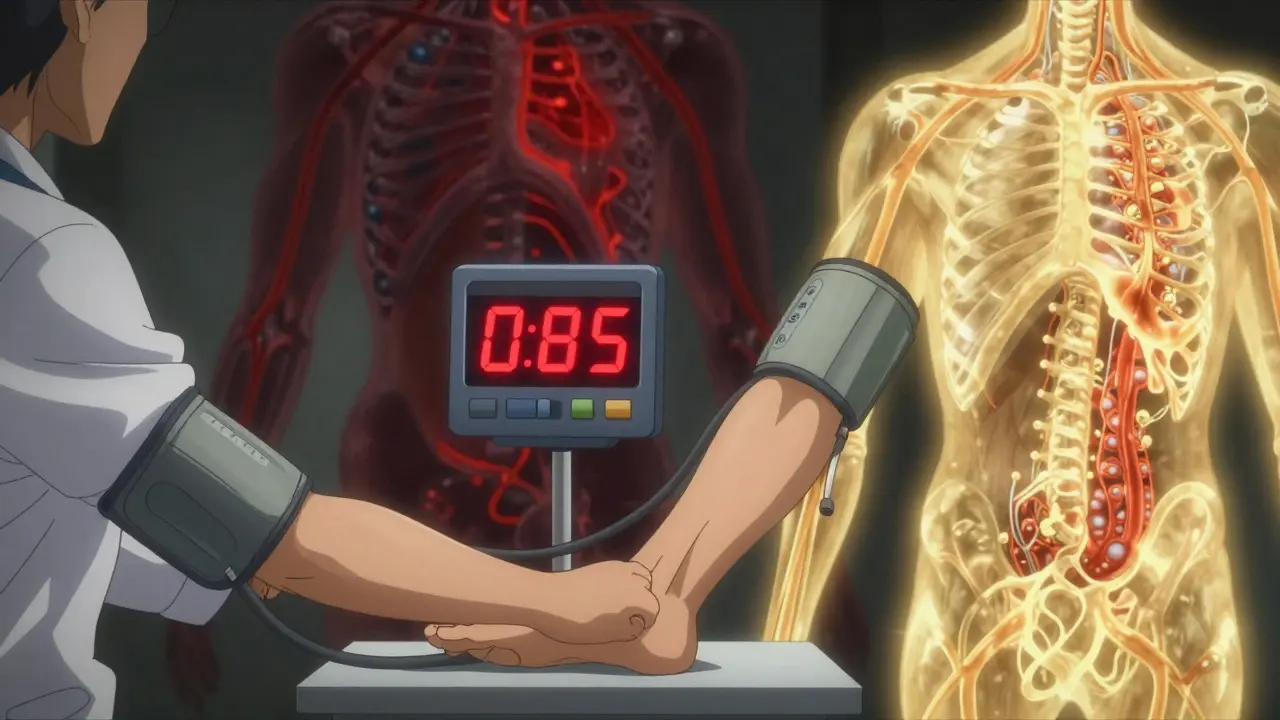
The first test most doctors use is simple, painless, and cheap: the ankle-brachial index (ABI). It measures blood pressure in your ankle and compares it to the pressure in your arm. If the ratio is 0.90 or lower, you have PAD. It’s 95% accurate. Yet, fewer than 20% of people who should get tested actually do.
Why? Because many doctors don’t screen unless symptoms are obvious. But if you’re over 65, or over 50 with diabetes or a history of smoking, you should be screened-even if you feel fine. The same goes for anyone over 40 with high blood pressure, high cholesterol, or a family history of heart disease.
For people with diabetes or kidney disease, the ABI can be misleading because their arteries become stiff. In those cases, doctors use the toe-brachial index (TBI). A TBI under 0.70 confirms PAD. Doppler ultrasound is another common tool-it uses sound waves to show how fast blood is moving and where blockages are. It’s non-invasive and catches about 90-95% of significant blockages.
If the blockage is severe or surgery is being considered, imaging like CT angiography or MRI angiography gives a detailed 3D picture of your arteries. The gold standard is catheter angiography, where dye is injected directly into the artery. It’s accurate, but it carries risks like kidney damage from the dye, so it’s usually saved for when treatment is planned.
Treatment That Actually Works
Many people assume PAD means you need surgery or stents. But the most effective treatment for most people? Walking. Not just any walking-structured, supervised exercise. A program of 30 to 45 minutes, three to five times a week, can double your walking distance in just 12 weeks. It forces your body to grow new tiny blood vessels, bypassing the blocked ones. This isn’t a guess-it’s backed by decades of research.
But exercise alone isn’t enough. Quitting smoking is the single most important thing you can do. If you keep smoking, your risk of amputation goes up by eight times. Your risk of dying from heart disease jumps by 300%. No medication can undo that damage.
Medications play three key roles:
- Antiplatelet drugs like aspirin or clopidogrel prevent clots. Clopidogrel is slightly better at preventing heart attacks and strokes in PAD patients.
- Statin therapy lowers LDL cholesterol to under 70 mg/dL. This isn’t just about cholesterol-it slows plaque buildup, stabilizes existing plaques, and reduces your risk of heart attack or stroke by 25-30%.
- Cilostazol is a pill that improves blood flow to the legs. It can boost walking distance by 50-100%, but it’s not safe if you have heart failure.
For patients with severe pain or non-healing wounds, procedures like angioplasty, stenting, or bypass surgery may be needed. Balloon angioplasty opens up narrow spots and works well for short blockages. Stents keep arteries open longer, especially in the upper leg. Atherectomy shaves off hard, calcified plaque. Bypass surgery, using a vein from your leg or a synthetic graft, is the longest-lasting option-80% of vein grafts stay open after five years.

Why Most People Miss the Warning Signs
Here’s the hard truth: PAD is massively underdiagnosed. Only one in five eligible patients get screened. Why? Because symptoms are often mistaken for arthritis, aging, or just being out of shape. Doctors don’t always ask about leg pain during routine visits. And patients rarely mention it unless it’s unbearable.
There’s also a deep racial gap. Black and Hispanic patients with PAD are 30-40% less likely to get revascularization procedures-even when their disease is just as severe. This isn’t about access alone; it’s about awareness, bias, and systemic gaps in care.
The 5-year mortality rate for PAD is 30-40%. That’s worse than many cancers. But unlike cancer, PAD is preventable. If caught early, it can be managed without surgery. The tools are there. The tests are simple. The treatments work.
What You Can Do Today
If you’re over 50 and smoke, or have diabetes, or have high blood pressure-get your ABI checked. It takes less than 10 minutes. No needles. No radiation. Just two blood pressure cuffs.
If you’re already diagnosed:
- Walk every day-even if it hurts. Start with 10 minutes, rest, then repeat. Gradually build up.
- Quit smoking. Period. No exceptions.
- Take your statin and antiplatelet meds as prescribed. Don’t skip them.
- Check your feet daily. Look for sores, color changes, or swelling.
- Control your blood sugar, blood pressure, and cholesterol. They all feed the disease.
There’s no magic pill. No miracle cure. But there is a clear path forward: awareness, action, and consistency. PAD doesn’t have to mean losing your mobility-or your life. But you have to act before it’s too late.
Can you have PAD without leg pain?
Yes. Up to 40% of people with PAD don’t experience classic claudication. They might just feel tired, notice changes in their skin or toenails, or have erectile dysfunction. That’s why screening with ABI is so important-even if you feel fine, especially if you’re over 50 with risk factors.
Is PAD the same as heart disease?
PAD isn’t heart disease, but it’s a major red flag for it. PAD means atherosclerosis is happening in your leg arteries-and likely in your heart and brain too. People with PAD have a 3 to 5 times higher risk of heart attack or stroke. Treating PAD isn’t just about your legs-it’s about protecting your heart and brain.
Does walking really help with PAD?
Yes, and it’s the most effective first-line treatment. Supervised walking programs increase pain-free walking distance by 150-200% in 12 weeks. It works by training your body to create new tiny blood vessels around blockages. No drug or surgery has been shown to do this as reliably or safely.
Can you reverse PAD?
You can’t fully reverse existing plaque, but you can stop it from getting worse-and even improve blood flow. Quitting smoking, taking statins, controlling blood pressure, and exercising regularly can stabilize plaques, reduce inflammation, and encourage the growth of new collateral vessels. Many people regain mobility and avoid amputation with consistent management.
What happens if PAD is left untreated?
Untreated PAD leads to worsening pain, non-healing wounds, tissue death (gangrene), and eventually amputation. It also dramatically increases your risk of heart attack and stroke. The 5-year death rate for untreated PAD is 30-40%. Early detection and management can cut that risk in half.
Comments
matthew runcie
Been dealing with this for years. Started walking 10 mins a day after my doc mentioned PAD. Didn’t believe it at first. Now I can walk a mile without stopping. No meds, no surgery. Just feet on the ground.
shannon kozee
ABI test is free at most clinics. If you're over 50 and smoked even once, get it done. Seriously. It takes 5 minutes. No reason to wait until you can't walk.
Shaun Wakashige
Walking helps? Lol. I tried that. My legs hurt worse. Now I just sit. 🤷♂️
trudale hampton
My dad had PAD. He quit smoking, started walking, took his statin. No amputation. No heart attack. Just lived. It’s not magic. It’s consistency.
Natali Shevchenko
It’s wild how medicine ignores the body’s signals until they scream. PAD isn’t just a leg issue-it’s the body’s quiet cry that the whole system is crumbling. We treat symptoms like they’re isolated. But arteries don’t clog in one place. They whisper first. Then they beg. Then they collapse. And we call it aging. We call it laziness. We call it ‘just getting older.’ But it’s not. It’s systemic failure. And we’re too busy to listen until it’s too late.
Johny Prayogi
YES! 🙌 I got my ABI done after reading this. 0.82. Scared me straight. Quit smoking. Started walking. 3 weeks in and I’m already climbing stairs without gasping. This stuff works. Do it. Now.
Jackie Tucker
Of course the article says walking works. It’s cheap. No profit in telling people to walk. The real industry is stents, angioplasty, and fancy imaging. But hey, at least we get to feel good about our treadmill purchases.
Thomas Jensen
They don’t want you to know this but the real cause of PAD is 5G radiation and chemtrails. Your arteries don’t clog from cholesterol. They clog from government tracking signals. The ABI test? It’s a scam. They’re just trying to get you to go to the clinic so they can implant microchips. I’ve seen the videos. Don’t trust doctors. Trust your gut.
Sandy Wells
Walking helps? Whatever. I’m 72. I’ve got arthritis. My legs ache anyway. Why bother? It’s not like I’m gonna run a marathon. Just let me be.
Solomon Kindie
Statins dont work they just lower cholesterol numbers but the plaque still builds up and the docs dont even look at inflammation markers like lpa or crp they just push pills and tell you to walk like its some kind of cure all but what if your body cant make new vessels what then hmm