
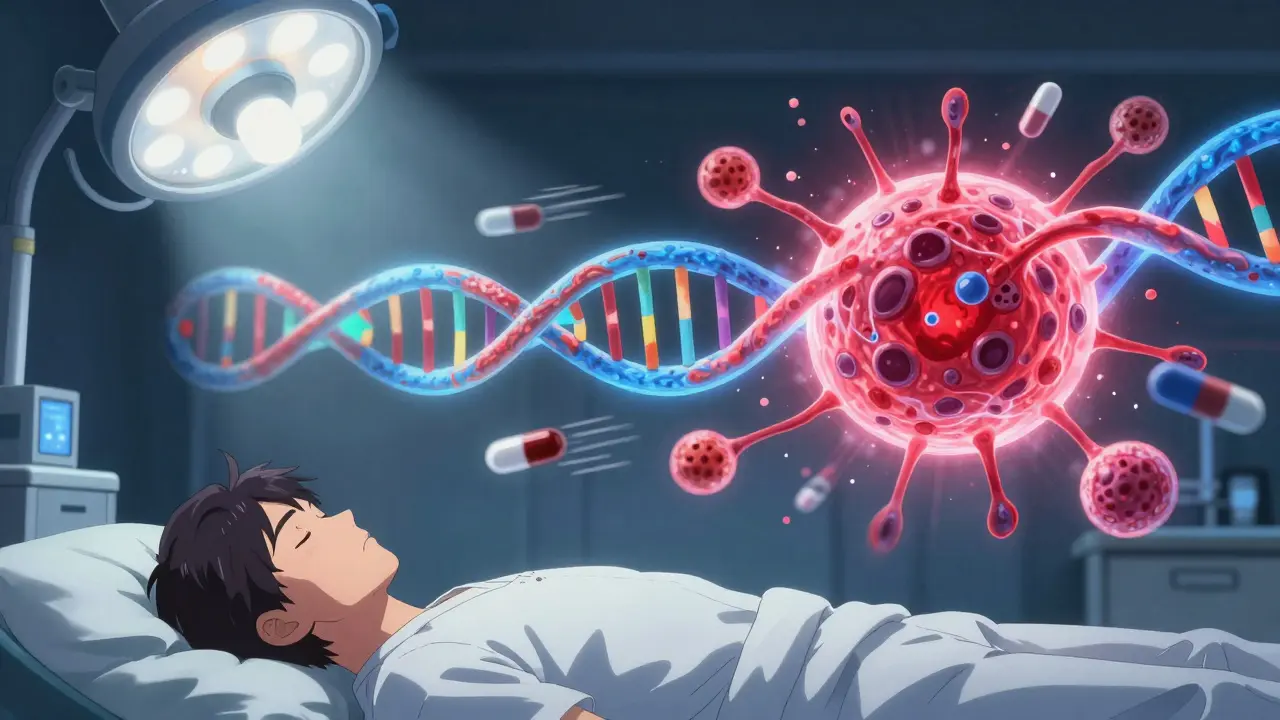
For decades, cancer treatment meant one thing: chemotherapy. Harsh, broad, and brutal. It attacked every fast-dividing cell in the body-cancerous or not. Hair loss, nausea, fatigue, immune collapse. Many patients didn’t just fight the tumor-they fought the treatment too. But today, something quieter, smarter, and more precise is reshaping how we treat cancer: targeted therapy.
Targeted therapy doesn’t guess. It doesn’t scatter shot. It reads the DNA of your tumor and hunts down the exact molecular flaw that’s making it grow. This is precision medicine in action. No more one-size-fits-all. Now, treatment is built around your tumor’s unique genetic fingerprint.
How Targeted Therapy Works: Reading the Code
Every cancer has a story written in its DNA. Sometimes, a gene mutates and starts screaming at cells to divide nonstop. Other times, a gene that normally stops cancer gets broken. Targeted therapies are drugs designed to block those faulty signals.
Think of it like this: if cancer is a car with a stuck gas pedal, chemotherapy is smashing the whole engine. Targeted therapy? It finds the faulty pedal and cuts the wire. For example, drugs like osimertinib lock onto EGFR mutations in lung cancer. Trastuzumab grabs onto HER2 proteins in breast cancer. Selpercatinib zeroes in on RET gene changes, no matter where the tumor is in the body.
This isn’t theory. It’s clinical reality. In EGFR-mutant non-small cell lung cancer, osimertinib extends progression-free survival to nearly 19 months-almost double what chemotherapy achieves. Larotrectinib, a drug approved for tumors with NTRK gene fusions, works across 17 different cancer types. That’s the power of targeting the mutation, not the organ.
The Science Behind the Shift
The foundation of this revolution? The Cancer Genome Atlas. Launched in 2006, this massive project mapped mutations across more than 20,000 tumors in 33 cancer types. Suddenly, doctors weren’t just seeing lung cancer or colon cancer-they were seeing EGFR-mutant lung cancer, BRAF-mutant melanoma, or BRCA1-deficient ovarian cancer.
Today, 73% of new cancer drugs approved by the FDA are targeted therapies. Over 68 genetically targeted drugs are now in use. And it’s not just about killing cells-it’s about controlling cancer as a chronic condition. Imatinib, the first targeted therapy approved in 2001, turned chronic myeloid leukemia from a death sentence into a manageable disease for most patients.
Two main types of drugs dominate this space:
- Small molecule inhibitors-pills that slip inside cells and block signals from mutated proteins. Examples: osimertinib, dabrafenib.
- Monoclonal antibodies-injectable proteins that latch onto targets on the cell surface. Examples: trastuzumab, cetuximab.
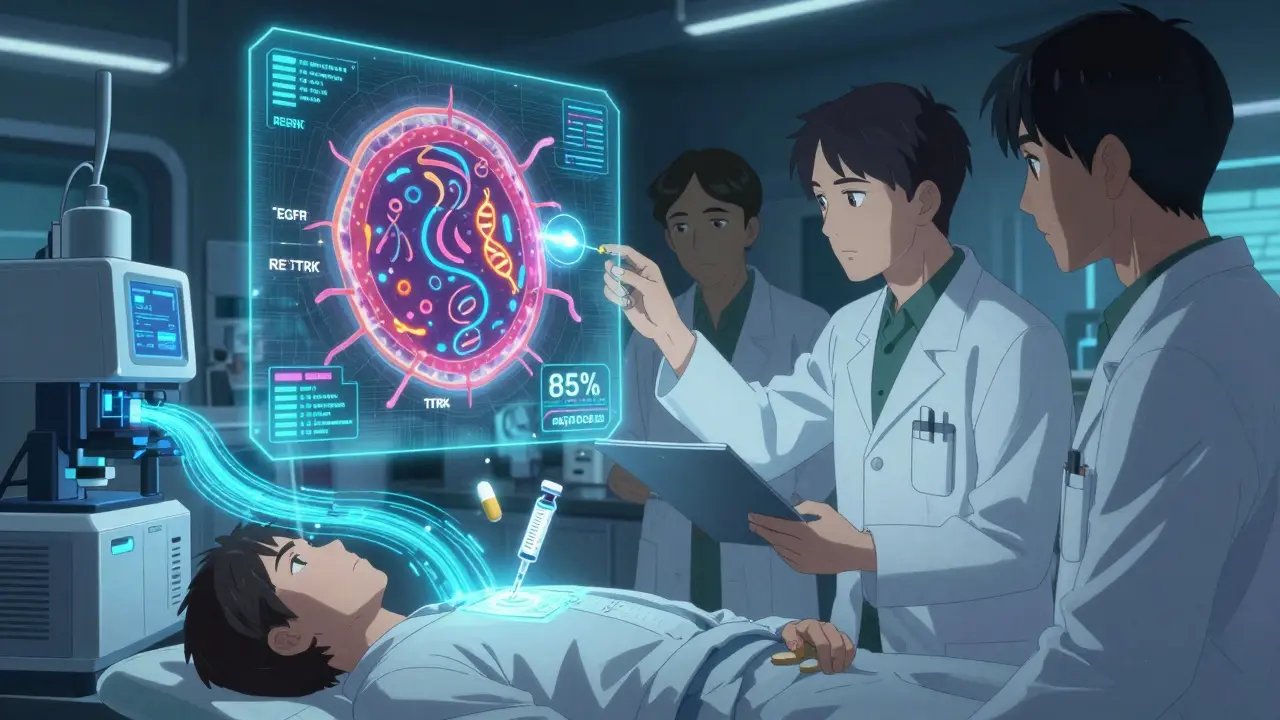
Both rely on one thing: biomarker testing. Before any targeted therapy is given, your tumor must be analyzed. That means next-generation sequencing (NGS), which reads hundreds of cancer-related genes at once. Tests like FoundationOne CDx or MSK-IMPACT look at 300-500 genes. A single sample, as little as 20 nanograms of DNA, can reveal whether you’re a candidate.
Why It Works Better-For Some
The numbers speak for themselves. In patients with the right mutation:
- Response rates for selpercatinib in RET-mutant lung cancer: 85% (vs. 30-40% with chemo)
- Response rates for larotrectinib in NTRK-fusion cancers: 75%
- Progression-free survival with osimertinib: 18.9 months vs. 10.2 months with chemo
And side effects? Much gentler. While chemotherapy causes severe toxicity in 50-70% of patients, targeted therapies trigger serious side effects in only 15-30%. Many patients report being able to work, travel, and live normally while on treatment.
One patient with stage IV lung cancer described it this way: “After starting osimertinib, my tumor shrank 80% in eight weeks. No vomiting. No crushing fatigue. I slept through the night for the first time in years.”
This is why oncologists now call molecular profiling the standard of care for advanced cancers. But here’s the catch: it only works if your tumor has a targetable mutation.
The Hard Truth: Not Everyone Benefits
Here’s where the reality check hits. Only about 13.8% of cancer patients currently qualify for genomically matched targeted therapies. Even in top academic centers, only 10-15% of solid tumors have an approved drug for their mutation.
Why? Because most cancer mutations are still untouchable. We have drugs for EGFR, ALK, BRAF, HER2, RET, NTRK-but what about TP53? PTEN? KRAS? These are common drivers, yet we have no drugs that can fix them. Dr. Levi Garraway of Genentech put it bluntly: “Targeting tumor suppressor genes accounts for 80% of driver mutations, but we have no approved therapies.”
And even when a drug works, resistance often follows. In 70-90% of cases, the cancer finds a way around the drug within 9-14 months. New mutations pop up. The tumor evolves. Liquid biopsies-blood tests that detect tumor DNA-are helping here. Guardant360, approved in 2023, can spot resistance mutations months before scans show progression.
Then there’s access. In the U.S., 65% of advanced cancer patients get genomic testing. In Europe? 22%. In Asia? 8%. And even when testing is done, insurance often denies coverage. A 2022 ASCO survey found 55% of patients faced insurance delays for testing. One Reddit user wrote: “My NTRK fusion makes me eligible for larotrectinib. But my insurance denied it because it’s ‘not standard for my cancer type.’”
The Cost and the Crisis
Targeted therapy isn’t cheap. Monthly costs range from $15,000 to $30,000. Chemotherapy? $5,000-$10,000. That gap creates financial toxicity. A University of Chicago study found 40% of patients on targeted drugs reported serious financial hardship-debt, skipping meals, or delaying care.
And it’s not just money. There’s a knowledge gap. Only 42% of community oncology practices have access to comprehensive genomic testing. Many doctors aren’t trained to interpret complex reports. Variants of unknown significance (VUS)-mutations we don’t yet understand-show up in 20-30% of tests. What do you do then?
That’s why molecular tumor boards exist. Teams of oncologists, pathologists, genetic counselors, and bioinformaticians meet weekly to review cases. At top centers like MD Anderson, these boards are standard. But only 32% of community hospitals have them.

What’s Next? The Road Ahead
The future is layered. First, liquid biopsies will become routine-not just for diagnosis, but for real-time monitoring. Second, combination therapies are being tested: targeted drugs paired with immunotherapy or drugs that target the tumor’s environment. Third, AI is stepping in. IBM Watson for Oncology matched tumor board recommendations 93% of the time in a 2024 study.
The FDA’s Project Orbis lets countries share data on targeted therapies faster. The NCI’s RESPOND initiative is tackling racial disparities in access. And by 2030, experts predict 40% of cancer patients will receive biomarker-driven treatment.
But progress won’t be linear. We still lack drugs for the majority of mutations. Testing access remains unequal. Costs are unsustainable. And for patients with rare mutations, the wait for a match can feel endless.
What This Means for Patients
If you or a loved one has advanced cancer, ask this: “Has my tumor been genomically tested?” If not, push for it. Don’t wait. Ask if your oncologist works with a molecular tumor board. If they don’t, ask about resources like the Personalized Oncology Alliance, which offers free expert reviews for community practices.
Know your options. Know your mutation. And know that while targeted therapy isn’t a cure for everyone, it’s turning terminal cancers into manageable conditions-for those who can access it.
What is targeted therapy in cancer treatment?
Targeted therapy is a type of cancer treatment that uses drugs or other substances to specifically attack cancer cells based on their unique genetic mutations. Unlike chemotherapy, which affects all rapidly dividing cells, targeted therapies focus on specific proteins or pathways that drive tumor growth, reducing harm to healthy tissue.
How is targeted therapy different from chemotherapy?
Chemotherapy attacks all fast-growing cells, leading to widespread side effects like hair loss, nausea, and low immunity. Targeted therapy works only on cancer cells with specific genetic changes, so side effects are usually milder and more predictable. For example, targeted drugs may cause skin rashes or high blood pressure instead of vomiting or fatigue.
Do all cancer patients qualify for targeted therapy?
No. Only about 13.8% of cancer patients currently have tumors with mutations that match an approved targeted drug. Testing through next-generation sequencing is required to identify these mutations. Even then, many common mutations-like TP53 or PTEN-still have no targeted drugs available.
What tests are needed before starting targeted therapy?
A tumor sample is analyzed using next-generation sequencing (NGS) panels like FoundationOne CDx or MSK-IMPACT. These tests examine 300-500 cancer-related genes to find mutations, fusions, or amplifications. Blood-based liquid biopsies are also becoming common for monitoring. The sample needs at least 20 nanograms of DNA and 20% tumor cellularity to be reliable.
Why do some patients stop responding to targeted therapy?
Cancer cells evolve. Even when a targeted drug works well, the tumor often develops new mutations that bypass the drug’s mechanism. This is called acquired resistance. In 70-90% of cases, resistance appears within 9-14 months. Liquid biopsies can detect these new mutations early, helping doctors switch to a new treatment before the cancer spreads.
Are targeted therapies covered by insurance?
Coverage varies widely. While many targeted drugs are FDA-approved, insurers sometimes deny coverage for off-label use or rare mutations. Biomarker testing is also frequently delayed or denied. In 2022, 55% of patients reported insurance barriers to testing, and 28% waited over four weeks for approval. Patient advocacy groups and molecular tumor boards can help appeal these decisions.
What is a molecular tumor board?
A molecular tumor board is a multidisciplinary team of oncologists, pathologists, genetic counselors, and bioinformaticians who review complex cancer cases. They interpret genetic test results, identify potential targeted therapies-even off-label ones-and recommend personalized treatment plans. These boards are standard in major cancer centers but still rare in community hospitals.
Can targeted therapy work for rare cancer types?
Yes. Some targeted therapies are approved based on the mutation, not the tumor’s location. For example, larotrectinib and entrectinib are approved for any solid tumor with an NTRK gene fusion-whether it’s in the lung, breast, thyroid, or salivary gland. This is called a tissue-agnostic approval, and it’s changing how rare cancers are treated.
Comments
Ian Kiplagat
This is why I keep telling people: cancer isn't one disease. It's hundreds.
Targeted therapy is the first time we're treating the *why*, not just the *where*.
Still... the access gap is criminal. 🤔
Bridget Verwey
So we have drugs that work miracles... but only if you're rich, white, and live near a major city.
Let’s not call this progress. Call it a luxury subscription.
Amina Aminkhuslen
I read this and immediately thought: we're playing God with biotech while people can't afford insulin.
Targeted therapy? More like targeted privilege.
And don't even get me started on those $30k/month pills that 'manage' cancer like it's a Netflix subscription.
Roland Silber
One thing people miss: targeted therapies don't just work because they're smart-they work because we finally stopped treating all lung cancers the same.
That shift-from organ-based to mutation-based-was the real breakthrough.
And yes, resistance happens. But liquid biopsies are turning that from a dead end into a detour.
We're not curing cancer yet. But we're learning how to outmaneuver it.
That's huge.
amber carrillo
My sister was on osimertinib for 14 months. She traveled, worked part-time, and slept through the night.
That wasn't just treatment. That was life.
Adebayo Muhammad
Ah, yes. The new gospel of precision medicine: 'We have drugs for your mutation!'
But what about the 86% of patients whose tumors are too 'messy' for this shiny new toy?
And let's not forget-most of these drugs were developed by corporations whose primary goal is profit, not parity.
So we get miracles for the few, and silence for the many.
It's not science. It's capitalism with a lab coat.
Tim Hnatko
I work in a community clinic. We send out 3-4 NGS tests a month. Two get denied. One comes back with 5 VUS.
We don't have a tumor board. We have Google and a prayer.
Joey Pearson
If your oncologist hasn't mentioned genomic testing by your second appointment, ask again. And again.
You deserve to know what you're fighting.
And yes, it's worth the fight.
Aaron Pace
I know someone who got denied insurance for a test because her tumor was 'too rare'... then found out her mutation was in a drug approved for thyroid cancer.
She's alive today because she found a doctor who googled harder than her insurer.
So yeah. Keep pushing. 💪