
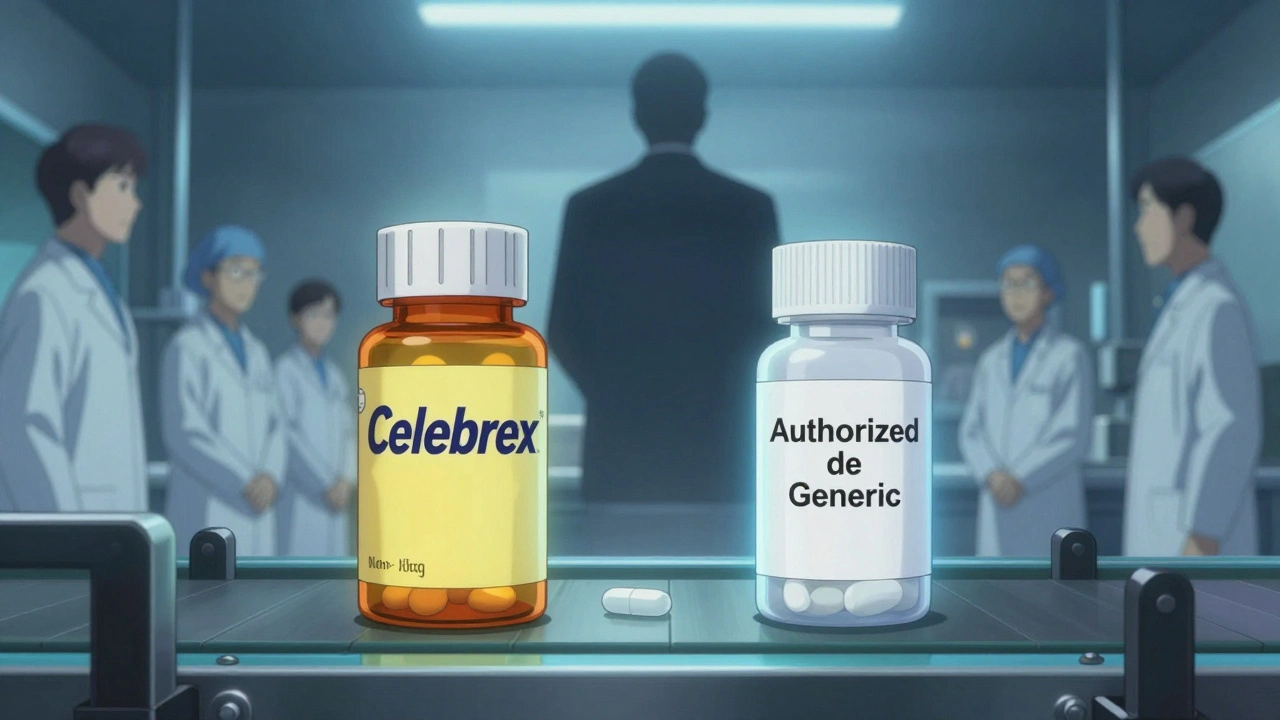
When a blockbuster drug loses its patent, the brand company doesn’t just sit back and watch its revenue vanish. Instead, many of them launch something surprising: an authorized generic. It’s the exact same pill, same dose, same factory - but without the brand name. No fancy packaging. No TV ads. Just a lower price tag. And it’s not a mistake. It’s a calculated move.
What Exactly Is an Authorized Generic?
An authorized generic is a version of a brand-name drug made by the original manufacturer and sold under a generic label. It contains the same active and inactive ingredients, same manufacturing process, same quality control - everything. The only difference? The box says "generic" instead of "Celebrex" or "Concerta." Unlike traditional generics, which are made by other companies after proving bioequivalence to the brand, authorized generics skip that whole process. They’re produced under the brand’s original FDA approval (the NDA), so they don’t need a separate application. That means they hit the market faster - sometimes within weeks of patent expiry. For example, when Pfizer’s Celebrex lost patent protection, its authorized generic, made by Greenstone (a Pfizer subsidiary), appeared on shelves almost immediately. Same capsule. Same filling. Same quality. Just cheaper.Why Do Brand Companies Do This?
It seems counterintuitive. Why would a company undercut its own product? The answer is simple: to survive. When a drug’s patent expires, generic competitors flood the market. Prices drop fast - often by 80% or more in the first year. Brand manufacturers can lose 90% of their revenue. That’s not just a loss. It’s a collapse. By launching an authorized generic, the brand company doesn’t just watch the market slip away. They grab a piece of it back. Think of it like this: Imagine you own a popular coffee shop. One day, a new café opens across the street selling the exact same coffee for half the price. You could close your doors… or you could open a second counter with the same beans, same baristas, same cups - but labeled "Budget Brew." You keep your customers, you keep your staff, and you still make money. That’s what authorized generics do.Targeting the 180-Day Exclusivity Window
The real power move happens during the 180-day exclusivity period granted to the first generic company under the Hatch-Waxman Act. That first generic gets a head start - no competition for six months. They can charge higher prices, lock in pharmacy contracts, and build market share. But if the brand company launches an authorized generic during that window? Everything changes. Suddenly, there are two versions of the same drug on the shelf: the "first generic" and the "brand’s own generic." Prices plummet. The first generic can’t charge premium prices anymore. Their monopoly is broken before it even starts. The Federal Trade Commission confirmed this in a 2011 report: when brand companies launched authorized generics during the 180-day window, prices were significantly lower than in markets without them. Consumers won. The first generic lost its profit windfall. And the brand company? They kept a slice of the pie. This isn’t theory. It’s been done hundreds of times. Between 2010 and 2019, U.S. markets saw 854 authorized generic launches. And in 70% of cases where the 180-day exclusivity applied, the brand launched their version before or during that window.
Price Discrimination Without the Backlash
Brand companies aren’t just trying to survive. They’re trying to maximize value. They use authorized generics to split the market into two groups:- Patients and insurers willing to pay more for the brand name (often because of loyalty, habit, or perceived quality)
- Patients and payers who want the same drug at the lowest possible price
Why Authorized Generics Beat Traditional Generics
Traditional generics can be cheaper - but they’re not always the same. The FDA only requires that generics have the same active ingredient and be bioequivalent. That means they can have different fillers, binders, dyes, or coatings. For most drugs, that doesn’t matter. But for drugs with narrow therapeutic windows - like warfarin, levothyroxine, or seizure medications - even small differences can affect how the body absorbs the drug. Patients on these drugs often report better consistency with the brand. That’s why many doctors and patients prefer the authorized generic: it’s the exact same formulation they’ve always trusted. No guesswork. No switching side effects. A 2005 Roper Public Affairs study found that over 80% of Americans wanted the option to buy an authorized generic. Why? Because they knew it was the same drug - just cheaper.It’s Not Just Reactive - It’s Proactive
In the past, brand companies waited until a generic competitor showed up. Then they responded. Now? They’re getting ahead of the game. Recent data from 2020-2023 shows more brand companies are launching authorized generics even before the first generic hits the market. It’s a preemptive strike. They’re saying: "We know you’re coming. So we’re already here. And we’re cheaper than you can afford to be." This shift is changing the rules. Generic manufacturers now face more risk. Why invest millions to develop a generic if the brand company can flood the market with an identical version before you even launch? Some companies are even testing new distribution tactics - selling authorized generics only through mail-order pharmacies or specific chains to avoid direct price comparisons with their brand. It’s subtle. But it works.
The Financial Math Behind the Move
Let’s say a drug does $1 billion in annual sales before patent expiry. After generics enter, the brand’s revenue might drop to $100-200 million. But if the brand launches an authorized generic and captures 15-20% of the generic market - which could be 60-70% of the original volume - they could preserve $100-150 million in annual revenue. That’s not just survival. That’s stability. Plus, they keep their manufacturing lines running. Their workforce employed. Their supply chain intact. For a company that spent billions developing the drug, that’s worth holding onto. Companies like Greenstone (Pfizer), Prasco (Colcrys), and Amneal (formerly Impax) now have entire divisions built around authorized generics. It’s not a side project. It’s a core business.What’s Next? Authorized Biosimilars
The same logic is starting to apply to biologics - complex drugs made from living cells, like Humira or Enbrel. These drugs are the new blockbusters. And their patents are starting to expire. The FDA hasn’t officially defined "authorized biosimilars" yet. But the industry is watching closely. If a brand company can produce its own biosimilar version - identical to the original - and sell it under a generic label, they’ll have the same strategic advantage. The FTC and other regulators are already monitoring this space. So far, the trend shows that when authorized generics are introduced, prices drop. Patients win. Generic competitors get squeezed. And brand companies stay in the game.Bottom Line: It’s Not Cheating. It’s Strategy.
Authorized generics aren’t a loophole. They’re a legal, FDA-approved tool. And they’re being used with precision. Brand companies don’t launch them out of generosity. They do it because they have to. The market forces are too strong. If they don’t act, they disappear. But by launching an authorized generic, they turn a threat into a control point. They keep their customers. They keep their profits. And they keep the exact same drug available - no compromises. For patients, it means more choices. For payers, it means lower costs. For the industry, it means a smarter, more competitive market. This isn’t the end of brand drugs. It’s the evolution of how they survive.Are authorized generics the same as brand-name drugs?
Yes. Authorized generics contain the exact same active and inactive ingredients, are made in the same facility, and follow the same manufacturing process as the brand-name drug. The only difference is the label and packaging. They are not generic imitations - they are the original drug sold under a different name.
Why are authorized generics cheaper than the brand version?
They’re cheaper because they don’t carry the marketing, advertising, and brand-building costs of the original drug. The manufacturer saves on promotions and passes those savings to the market. Since they’re sold as generics, pharmacies and insurers negotiate lower prices for them, just like any other generic.
Do authorized generics affect the first generic company’s profits?
Yes, often significantly. When a brand company launches an authorized generic during the first generic’s 180-day exclusivity period, it breaks their monopoly. Prices drop faster, and the first generic can’t charge premium rates. This is intentional - it limits the financial reward for being first, which can discourage aggressive generic entry in the future.
Can I trust an authorized generic as much as the brand?
Absolutely. Since it’s made by the same company, using the same formula and production line, there’s no risk of formulation differences. For drugs where small changes matter - like thyroid meds or blood thinners - many doctors and patients prefer authorized generics over traditional generics because they’re identical to what they’ve been taking.
How do I know if a drug has an authorized generic?
Check the drug’s label or ask your pharmacist. Authorized generics are often listed in databases like GoodRx or the FDA’s Orange Book. The label will say the name of the brand drug (e.g., "Celecoxib, an authorized generic of Celebrex"). You can also search online using the brand name + "authorized generic" to find current options.
Are authorized generics available for all brand drugs?
No. Only brand companies choose to launch them - and they usually do it for high-revenue drugs facing serious generic competition. For low-cost or low-demand drugs, it’s not worth the effort. The strategy is reserved for blockbuster medications where preserving even a small share of the market means millions in retained revenue.
Comments
Jay Everett
Yo, this is wild but makes total sense 🤯 Brand companies are basically playing 4D chess while everyone else is stuck on checkers. Authorized generics? It’s like they’re saying, ‘You want cheap? Here’s the *exact same thing*-just without the logo.’ Genius. And kinda ruthless. But hey, capitalism, right? 😅
Shannara Jenkins
This is actually really reassuring for patients. I’ve had friends switch to generics and get weird side effects-then found out it was a different filler. Knowing there’s an authorized version that’s literally the same pill? That’s peace of mind. 👏
मनोज कुमार
Patent cliff exploitation via authorized generics. Classic pharma rent-seeking. 180-day exclusivity circumvented via vertical integration. Regulatory arbitrage at scale. FDA’s NDA loophole enables strategic market capture. No innovation. Just monetization. Endgame: consolidation.
Source: JAMA 2021
Elizabeth Grace
I used to think these companies were evil for charging $500 for a pill… then I found out they’re making the same pill for $5 and selling it right next to it. Now I’m just confused. Are they the villains or the heroes? 🤔
Steve Enck
The structural economic logic here is impeccable. The brand manufacturer internalizes the external competitive pressure by preemptively commodifying its own intellectual property. This is not a failure of market dynamics-it is the optimization of rent extraction under regulatory constraints. The 180-day exclusivity window is not a protection; it is a vulnerability exploited through vertical integration. The FTC’s findings confirm that consumer welfare increases, but shareholder welfare increases more. This is not a moral dilemma. It is a Nash equilibrium in pharmaceutical oligopoly.
One must recognize that the NDA is not a patent. It is a regulatory asset. And like all regulatory assets, it is subject to strategic deployment. The authorized generic is not a betrayal of the brand-it is the logical extension of brand equity into the generic tier. The consumer does not lose. The brand does not lose. Only the independent generic entrant loses. And that is the entire point.
This strategy is not new. It is the natural evolution of patent lifecycle management. What is new is the scale and precision with which it is now deployed. The days of waiting for a generic to appear are over. The brand now enters the generic market before the generic even files. This is not reactive. It is anticipatory. It is preemptive. It is systemic.
The implications for innovation are profound. Why invest $2 billion in a new molecule if the incumbent can replicate your entry with zero R&D and undercut your pricing before you even launch? The incentive structure is being rewritten. The FDA’s approval framework, designed for safety, now inadvertently incentivizes strategic replication over true innovation.
And yet-there is no illegality. No fraud. No deception. Only cold, calculated, legally sanctioned market maneuvering. The system works exactly as designed. It is not broken. It is working perfectly. For those who designed it.
Alicia Marks
So glad there’s a way to save money without risking your health. You deserve the same medicine, just a better price. 💪
Joel Deang
wait so if i buy the authorized generic its literally the same as the brand?? like same factory same chemist same everything?? 😳 i thought generics were like… different?? this is wild. i’ve been paying extra for nothing for years. thanks for the info!! 🙌
Lynn Steiner
Of course the big pharma giants do this. They don’t care about you. They care about profits. This isn’t strategy-it’s exploitation. America’s healthcare system is broken and this is just another proof point. 💔
Paul Keller
It’s fascinating how the market’s evolution has forced pharmaceutical firms to become both monopolists and competitors simultaneously. The authorized generic is not merely a product-it is a behavioral intervention in the generic market. By entering the space before the first generic can consolidate, the brand neutralizes the incentive structure that the Hatch-Waxman Act intended to reward. The 180-day exclusivity was meant to encourage innovation in generic development. Instead, it has become a target for preemptive corporate countermeasures. The result is a paradox: the system designed to increase access to affordable drugs now facilitates the preservation of market dominance by the original manufacturer. The FDA, in granting the NDA pathway for authorized generics, inadvertently created a legal mechanism for oligopolistic collusion against independent entrants. The consumer benefits from lower prices, yes-but the structure of competition is eroded. This is not innovation. It is institutional capture. And while it is lawful, it is not equitable. The question is not whether it works-but whether it should be allowed to continue unchallenged.